![[ANSYS, Inc. Logo]](fluentlogo.gif)


|
|
|
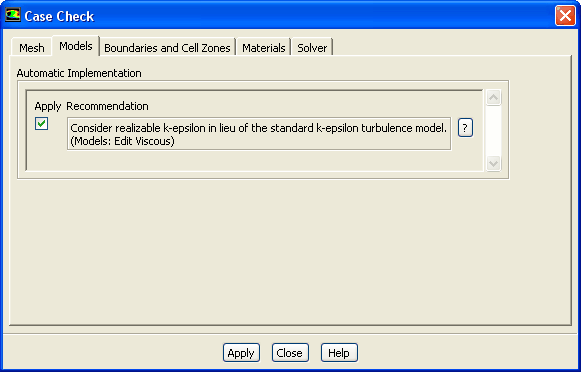
The following recommendations appear under the Models tab (Figure 26.17.4):
The realizable
 -
-
 model is a more recent development of the standard
 -
-
 model and differs from it in that the realizable
 -
-
 model contains a new formulation for the turbulent viscosity, as well as a new transport equation for the dissipation rate,
 , derived from an exact equation for the transport of the mean-square vorticity fluctuation.
realizable
 -
-
 model means that the model satisfies certain mathematical constraints on the Reynolds stresses, consistent with the physics of turbulent flows. For more information on the standard
 -
-
 model and the realizable
 -
-
 model, visit
this section and
this section (in the separate
Theory Guide), respectively.
model, visit
this section and
this section (in the separate
Theory Guide), respectively.
 Models

 Viscous
 Edit...
For information on all
 -
-
 model options, go to
this section in the separate
Theory Guide.
model options, go to
this section in the separate
Theory Guide.
DO/Energy coupling should only be used when the optical thickness is greater than 10. Refer to this section in the separate Theory Guide for more information.
 Models

 Radiation
 Edit...
When using the S2S radiation model, make sure that you use the correct partial enclosure temperature. In most cases this is the ambient temperature, which by default is set at 300K. See Section 13.3.6 for more information.
 Models

 Radiation
 Edit...
If you have created a mixing plane, set the Under-Relaxation in the Mixing Plane dialog box to 1. Look under Global Parameters in Section 10.10.2 for information about the mixing plane under-relaxation.
Define
 Mixing Planes...
When your case involves the use of dynamic meshes and remeshing is enabled, then it is recommended that you also perform smoothing on the mesh. For a complete discussion of smoothing and remeshing, see Section 11.3.1.
 Dynamic Mesh

 Dynamic Mesh
By default, ANSYS FLUENT includes the diffusion flux of species at inlets. In some cases involving species transport and laminar flow, it is recommended that the Inlet Diffusion option in the Species Model dialog box is disabled. For example,
 Models

 Species
 Edit...
For more information about diffusion at inlets, go to Section 15.1.5.
When running thermal NOx simulations and your flow is turbulent, then be sure to set the NOx Turbulence Interaction Mode.
 Models

 NOx
NOx
 Edit...
In turbulent combustion calculations, ANSYS FLUENT solves the density-weighted time-averaged Navier-Stokes equations for temperature, velocity, and species concentrations or mean mixture fraction and variance. Methods of modeling the mean turbulent reaction rate can be based on either moment methods or probability density function (PDF) techniques. ANSYS FLUENT uses the PDF approach.
To learn about how this feature is set up, go to Section 21.1.1.
When using the mixture multiphase model with the Singhal et. al cavitation model enabled, consider changing it to either the Schnerr-Sauer or the Zwart-Gerber-Belamri cavitation model. Refer to this section in the separate Theory Guide for more information.
 Phases
 Interaction...
Previous:
26.17.1 Checking the Mesh