![[ANSYS, Inc. Logo]](fluentlogo.gif)


|
|
|
 -
-
 Models
 When a non-zero gravity field and temperature gradient are present simultaneously, the
 -
-
 models in
ANSYS FLUENT account for the generation of
models in
ANSYS FLUENT account for the generation of
 due to buoyancy (
 in Equations
4.4-1,
4.4-4, and
4.4-15), and the corresponding contribution to the production of
in Equations
4.4-1,
4.4-4, and
4.4-15), and the corresponding contribution to the production of
 in Equations
4.4-2,
4.4-5, and
4.4-16.
in Equations
4.4-2,
4.4-5, and
4.4-16.
The generation of turbulence due to buoyancy is given by
where Pr
 is the turbulent Prandtl number for energy and
 is the component of the gravitational vector in the
 th direction. For the standard and realizable
 -
-
 models, the default value of Pr
 is 0.85. In the case of the RNG
 -
-
 model, Pr
 =
=
 , where
 is given by Equation
4.4-9, but with
is given by Equation
4.4-9, but with
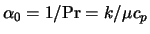 . The coefficient of thermal expansion,
 , is defined as
For ideal gases, Equation 4.4-23 reduces to
It can be seen from the transport equations for
 (Equations
4.4-1,
4.4-4, and
4.4-15) that turbulence kinetic energy tends to be augmented (
(Equations
4.4-1,
4.4-4, and
4.4-15) that turbulence kinetic energy tends to be augmented (
 ) in unstable stratification. For stable stratification, buoyancy tends to suppress the turbulence (
 ). In
ANSYS FLUENT, the effects of buoyancy on the generation of
). In
ANSYS FLUENT, the effects of buoyancy on the generation of
 are always included when you have both a non-zero gravity field and a non-zero temperature (or density) gradient.
While the buoyancy effects on the generation of
 are relatively well understood, the effect on
 is less clear. In
ANSYS FLUENT, by default, the buoyancy effects on
is less clear. In
ANSYS FLUENT, by default, the buoyancy effects on
 are neglected simply by setting
 to zero in the transport equation for
 (Equation
4.4-2,
4.4-5, or
4.4-16).
(Equation
4.4-2,
4.4-5, or
4.4-16).
However, you can include the buoyancy effects on
 in the
Viscous Model dialog box. In this case, the value of
in the
Viscous Model dialog box. In this case, the value of
 given by Equation
4.4-25 is used in the transport equation for
given by Equation
4.4-25 is used in the transport equation for
 (Equation
4.4-2,
4.4-5, or
4.4-16).
(Equation
4.4-2,
4.4-5, or
4.4-16).
The degree to which
 is affected by the buoyancy is determined by the constant
 . In
ANSYS FLUENT,
. In
ANSYS FLUENT,
 is not specified, but is instead calculated according to the following relation [
127]:
is not specified, but is instead calculated according to the following relation [
127]:
 |
(4.4-26) |
where
 is the component of the flow velocity parallel to the gravitational vector and
 is the component of the flow velocity perpendicular to the gravitational vector. In this way,
 will become 1 for buoyant shear layers for which the main flow direction is aligned with the direction of gravity. For buoyant shear layers that are perpendicular to the gravitational vector,
 will become zero.
Previous:
4.4.4 Modeling Turbulent Production


