![[ANSYS, Inc. Logo]](fluentlogo.gif)


|
|
|
 -
-
 Model
Model
Overview
The RNG
 -
-
 model was derived using a rigorous statistical technique (called renormalization group theory). It is similar in form to the standard
 -
-
 model, but includes the following refinements:
 equation that significantly improves the accuracy for rapidly strained flows.
 -
-
 model uses user-specified, constant values.
 -
-
 model is a high-Reynolds-number model, the RNG theory provides an analytically-derived differential formula for effective viscosity that accounts for low-Reynolds-number effects. Effective use of this feature does, however, depend on an appropriate treatment of the near-wall region.
 These features make the RNG
 -
-
 model more accurate and reliable for a wider class of flows than the standard
 -
-
 model.
The RNG-based
 -
-
 turbulence model is derived from the instantaneous Navier-Stokes equations, using a mathematical technique called "renormalization group'' (RNG) methods
. The analytical derivation results in a model with constants different from those in the standard
turbulence model is derived from the instantaneous Navier-Stokes equations, using a mathematical technique called "renormalization group'' (RNG) methods
. The analytical derivation results in a model with constants different from those in the standard
 -
-
 model, and additional terms and functions in the transport equations for
 and
and
 . A more comprehensive description of RNG theory and its application to turbulence can be found in [
259].
. A more comprehensive description of RNG theory and its application to turbulence can be found in [
259].
Transport Equations for the RNG
 -
-
 Model
Model
The RNG
 -
-
 model has a similar form to the standard
 -
-
 model:
and
In these equations,
 represents the generation of turbulence kinetic energy due to the mean velocity gradients, calculated as described in Section
4.4.4.
represents the generation of turbulence kinetic energy due to the mean velocity gradients, calculated as described in Section
4.4.4.
 is the generation of turbulence kinetic energy due to buoyancy, calculated as described in Section
4.4.5.
is the generation of turbulence kinetic energy due to buoyancy, calculated as described in Section
4.4.5.
 represents the contribution of the fluctuating dilatation in compressible turbulence to the overall dissipation rate, calculated as described in Section
4.4.6. The quantities
represents the contribution of the fluctuating dilatation in compressible turbulence to the overall dissipation rate, calculated as described in Section
4.4.6. The quantities
 and
and
 are the inverse effective Prandtl numbers for
 and
and
 , respectively.
 and
and
 are user-defined source terms.
Modeling the Effective Viscosity
The scale elimination procedure in RNG theory results in a differential equation for turbulent viscosity:
where
 |
 |
 |
|
 |
 |
 |
Equation
4.4-6 is integrated to obtain an accurate description of how the effective turbulent transport varies with the effective Reynolds number (or eddy scale), allowing the model to better handle low-Reynolds-number
and near-wall flows
.
In the high-Reynolds-number limit, Equation 4.4-6 gives
with
 , derived using RNG theory. It is interesting to note that this value of
 is very close to the empirically-determined value of 0.09 used in the standard
 -
-
 model.
In ANSYS FLUENT, by default, the effective viscosity is computed using the high-Reynolds-number form in Equation 4.4-7. However, there is an option available that allows you to use the differential relation given in Equation 4.4-6 when you need to include low-Reynolds-number effects.
RNG Swirl Modification
Turbulence, in general, is affected by rotation or swirl in the mean flow. The RNG model in ANSYS FLUENT provides an option to account for the effects of swirl or rotation by modifying the turbulent viscosity appropriately. The modification takes the following functional form:
where
 is the value of turbulent viscosity calculated without the swirl modification using either Equation
4.4-6 or Equation
4.4-7.
is the value of turbulent viscosity calculated without the swirl modification using either Equation
4.4-6 or Equation
4.4-7.
 is a characteristic swirl number evaluated within
ANSYS FLUENT, and
is a characteristic swirl number evaluated within
ANSYS FLUENT, and
 is a swirl constant that assumes different values depending on whether the flow is swirl-dominated or only mildly swirling. This swirl modification always takes effect for axisymmetric, swirling flows and three-dimensional flows when the RNG model is selected. For mildly swirling flows (the default in
ANSYS FLUENT),
is a swirl constant that assumes different values depending on whether the flow is swirl-dominated or only mildly swirling. This swirl modification always takes effect for axisymmetric, swirling flows and three-dimensional flows when the RNG model is selected. For mildly swirling flows (the default in
ANSYS FLUENT),
 is set to 0.07. For strongly swirling flows, however, a higher value of
 can be used.
Calculating the Inverse Effective Prandtl Numbers
The inverse effective Prandtl numbers,
 and
and
 , are computed using the following formula derived analytically by the RNG theory:
where
 . In the high-Reynolds-number limit (
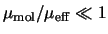 ),
),
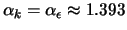 .
.
The
 Term in the
 Equation
The main difference between the RNG and standard
 -
-
 models lies in the additional term in the
 equation given by
where
 ,
,
 ,
,
 .
.
The effects of this term in the RNG
 equation can be seen more clearly by rearranging Equation
4.4-5. Using Equation
4.4-10, the third and fourth terms on the right-hand side of Equation
4.4-5 can be merged, and the resulting
equation can be seen more clearly by rearranging Equation
4.4-5. Using Equation
4.4-10, the third and fourth terms on the right-hand side of Equation
4.4-5 can be merged, and the resulting
 equation can be rewritten as
where
 is given by
 |
(4.4-12) |
In regions where
 , the
, the
 term makes a positive contribution, and
 becomes larger than
 . In the logarithmic layer, for instance, it can be shown that
 , giving
 , which is close in magnitude to the value of
 in the standard
 -
-
 model (1.92). As a result, for weakly to moderately strained flows, the RNG model tends to give results largely comparable to the standard
 -
-
 model.
In regions of large strain rate (
 ), however, the
 term makes a negative contribution, making the value of
 less than
 . In comparison with the standard
 -
-
 model, the smaller destruction of
 augments
 , reducing
 and, eventually, the effective viscosity. As a result, in rapidly strained flows, the RNG model yields a lower turbulent viscosity than the standard
 -
-
 model.
Thus, the RNG model is more responsive to the effects of rapid strain and streamline curvature than the standard
 -
-
 model, which explains the superior performance of the RNG model for certain classes of flows.
Model Constants
The model constants
 and
and
 in Equation
4.4-5 have values derived analytically by the RNG theory. These values, used by default in
ANSYS FLUENT, are
in Equation
4.4-5 have values derived analytically by the RNG theory. These values, used by default in
ANSYS FLUENT, are

Previous:
4.4.1 Standard - Model







