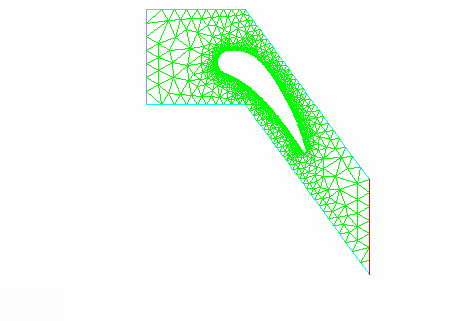
An example of effective use of adaption is in the solution of the compressible, turbulent flow through a 2D turbine cascade. The initial mesh around the blade is fine as shown in Figure
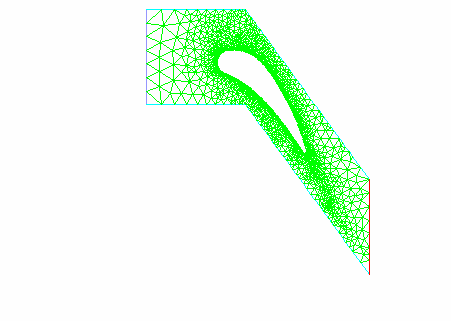
27.1.1. The surface node distribution thus provides adequate definition of the blade geometry, and enables the turbulent boundary layer to be properly resolved without further adaption. On the other hand, the mesh on the inlet, outlet, and periodic boundaries is comparatively coarse. To ensure that the flow in the blade passage is appropriately resolved, solution-adaptive refinement was used to create the mesh shown in Figure
27.1.2.
Figure 27.1.1: Turbine Cascade Mesh Before Adaption
Figure 27.1.2: Turbine Cascade Mesh after Adaption
Although the procedure for solution adaption will vary according to the flow being solved, the adaption process used for the turbine cascade is described in this example. Though this example involves compressible flow, the general procedure is applicable for incompressible flows as well.
1.
Display contours of pressure adaption function to determine a suitable refinement threshold (see Section
27.3).
2.
"Mark'' the cells within the refinement threshold, creating a refinement register (see
this section in the separate
Theory Guide and Section
27.3).
3.
Repeat the process described in steps 1 and 2, using gradients of Mach number as a refinement criterion.
4.
To refine in the wake region, use isovalues of total pressure as a criterion (see Section
27.5). This causes cells within the boundary layer and the wake to be marked, since these are both regions of high total-pressure loss.
6.
Limit the minimum cell volume for adaption to prevent the addition of cells within the boundary layer, where the mesh was judged to be fine enough already (see Section
27.12).
7.
Refine the cells contained in the resulting adaption register (see Section
27.11.1).
The effect of refining on gradients is evident in the finer mesh ahead of the leading edge of the blade and within the blade passage (Figure
27.1.2). The finer mesh in the wake region is due to the adaption using isovalues of total pressure.
![[ANSYS, Inc. Logo]](fluentlogo.gif)