![[ANSYS, Inc. Logo]](fluentlogo.gif)


|
|
|
The Weighted-Sum-of-Gray-Gases Model
The weighted-sum-of-gray-gases model (WSGGM) is a reasonable compromise between the oversimplified gray gas model and a complete model which takes into account particular absorption bands. The basic assumption of the WSGGM is that the total emissivity over the distance
 can be presented as
where
 is the emissivity weighting factor for the
 th fictitious gray gas, the bracketed quantity is the
 th fictitious gray gas emissivity,
 is the absorption coefficient of the
 th gray gas,
 is the sum of the partial pressures of all absorbing gases, and
 is the path length. For
 and
and
 ANSYS FLUENT uses values obtained from [
60] and [
326]. These values depend on gas composition, and
ANSYS FLUENT uses values obtained from [
60] and [
326]. These values depend on gas composition, and
 also depend on temperature. When the total pressure is not equal to 1 atm, scaling rules for
 are used (see Equation
5.3-87).
are used (see Equation
5.3-87).
The absorption coefficient for
 is assigned a value of zero to account for windows in the spectrum between spectral regions of high absorption (
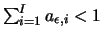 ) and the weighting factor for
 is evaluated from [
326]:
is evaluated from [
326]:
 |
(5.3-82) |
The temperature dependence of
 can be approximated by any function, but the most common approximation is
 |
(5.3-83) |
where
 are the emissivity gas temperature polynomial coefficients. The coefficients
 and
and
 are estimated by fitting Equation
5.3-81 to the table of total emissivities, obtained experimentally [
60,
70,
326].
are estimated by fitting Equation
5.3-81 to the table of total emissivities, obtained experimentally [
60,
70,
326].
The absorptivity
 of the radiation from the wall can be approximated in a similar way [
326], but, to simplify the problem, it is assumed that
of the radiation from the wall can be approximated in a similar way [
326], but, to simplify the problem, it is assumed that
 [
233]. This assumption is justified unless the medium is optically thin and the wall temperature differs considerably from the gas temperature.
[
233]. This assumption is justified unless the medium is optically thin and the wall temperature differs considerably from the gas temperature.
Since the coefficients
 and
and
 are slowly varying functions of
 and
and
 , they can be assumed constant for a wide range of these parameters. In [
326] these constant coefficients are presented for different relative pressures of the CO
, they can be assumed constant for a wide range of these parameters. In [
326] these constant coefficients are presented for different relative pressures of the CO
 and H
and H
 O vapor, assuming that the total pressure
 is 1 atm. The values of the coefficients shown in [
326] are valid for
is 1 atm. The values of the coefficients shown in [
326] are valid for
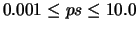 atm-m and
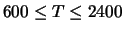 K. For
 K, coefficient values suggested by [
60] are used. If
K, coefficient values suggested by [
60] are used. If
 for all
 , Equation
5.3-81 simplifies to
, Equation
5.3-81 simplifies to
Comparing Equation
5.3-84 with the gray gas model with absorption coefficient
 , it can be seen that the change of the radiation intensity over the distance
 in the WSGGM is exactly the same as in the gray gas model with the absorption coefficient
which does not depend on
 . In the general case,
 is estimated as
where the emissivity
 for the WSGGM is computed using Equation
5.3-81.
for the WSGGM is computed using Equation
5.3-81.
 as defined by Equation
5.3-86 depends on
as defined by Equation
5.3-86 depends on
 , reflecting the non-gray nature of the absorption of thermal radiation in molecular gases. In
ANSYS FLUENT, Equation
5.3-85 is used when
, reflecting the non-gray nature of the absorption of thermal radiation in molecular gases. In
ANSYS FLUENT, Equation
5.3-85 is used when
 m and Equation
5.3-86 is used for
m and Equation
5.3-86 is used for
 m. Note that for
 m, the values of
 predicted by Equations
5.3-85 and
5.3-86 are practically identical (since Equation
5.3-86 reduces to Equation
5.3-85 in the limit of small
predicted by Equations
5.3-85 and
5.3-86 are practically identical (since Equation
5.3-86 reduces to Equation
5.3-85 in the limit of small
 ).
).
ANSYS FLUENT allows you to specify
 as the mean beam length or the characteristic cell size. The model based on the mean beam length is the recommended approach, especially when you have a nearly homogeneous medium and you are interested in the radiation exchange between the walls of the enclosure. You can specify the mean beam length or have
ANSYS FLUENT compute it. If you do decide to use the WSGGM based on the characteristic cell size, note that the predicted values of
as the mean beam length or the characteristic cell size. The model based on the mean beam length is the recommended approach, especially when you have a nearly homogeneous medium and you are interested in the radiation exchange between the walls of the enclosure. You can specify the mean beam length or have
ANSYS FLUENT compute it. If you do decide to use the WSGGM based on the characteristic cell size, note that the predicted values of
 will be mesh dependent (this is a known limitation of the model). See
this section in the separate
User's Guide for details about setting properties for the WSGGM.
will be mesh dependent (this is a known limitation of the model). See
this section in the separate
User's Guide for details about setting properties for the WSGGM.
|
|
The WSGGM cannot be used to specify the absorption coefficient in each band when using the non-gray DO model. If the WSGGM is used with the non-gray DO model, the absorption coefficient will be the same in all bands.
|
When
 atm
atm
The WSGGM, as described above, assumes that
 --the total (static) gas pressure--is equal to 1 atm. In cases where
 is not unity (e.g., combustion at high temperatures), scaling rules suggested in [
84] are used to introduce corrections. When
is not unity (e.g., combustion at high temperatures), scaling rules suggested in [
84] are used to introduce corrections. When
 atm or
 atm, the values for
 in Equations
5.3-81 and
5.3-85 are rescaled:
in Equations
5.3-81 and
5.3-85 are rescaled:
where
 is a non-dimensional value obtained from [
84], which depends on the partial pressures and temperature
is a non-dimensional value obtained from [
84], which depends on the partial pressures and temperature
 of the absorbing gases, as well as on
 .
.
The Effect of Soot on the Absorption Coefficient
When soot formation is computed, ANSYS FLUENT can include the effect of the soot concentration on the radiation absorption coefficient. The generalized soot model estimates the effect of the soot on radiative heat transfer by determining an effective absorption coefficient for soot. The absorption coefficient of a mixture of soot and an absorbing (radiating) gas is then calculated as the sum of the absorption coefficients of pure gas and pure soot:
 |
(5.3-88) |
where
 is the absorption coefficient of gas without soot (obtained from the WSGGM) and
with

 is the soot density in kg/m
 .
.
The coefficients
 and
and
 were obtained [
302] by fitting Equation
5.3-89 to data based on the Taylor-Foster approximation
[
348] and data based on the Smith et al. approximation [
326].
were obtained [
302] by fitting Equation
5.3-89 to data based on the Taylor-Foster approximation
[
348] and data based on the Smith et al. approximation [
326].
See this section and this section in the separate User's Guide for information about including the soot-radiation interaction effects.
The Effect of Particles on the Absorption Coefficient
ANSYS FLUENT can also include the effect of discrete phase particles on the radiation absorption coefficient, provided that you are using either the P-1 or the DO model. When the P-1 or DO model is active, radiation absorption by particles can be enabled. The particle emissivity, reflectivity, and scattering effects are then included in the calculation of the radiative heat transfer. See this section in the separate User's Guide for more details on the input of radiation properties for the discrete phase.
Previous:
5.3.7 Surface-to-Surface (S2S) Radiation






![a_s = b_1 \rho_m [1 + b_T (T - 2000)]](img2901.gif)