![[ANSYS, Inc. Logo]](fluentlogo.gif)


|
|
|
The Fourier transform utility in
ANSYS FLUENT allows you to compute the Fourier transform of a signal,
 , a real-valued function, from a finite number of its sampled points.
The discrete Fourier transform of
 is defined by
 are the discrete Fourier coefficients, which can be obtained from
Equation 29.11-7 and Equation 29.11-8 form a Fourier transform pair that allows us to determine one from the other.
Note that when we follow the convention of varying
 from 0 to
 in Equation
29.11-7 or Equation
29.11-8 instead of from
in Equation
29.11-7 or Equation
29.11-8 instead of from
 to
to
 , the range of index
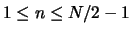 corresponds to positive frequencies, and the range of index
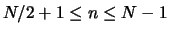 corresponds to negative frequencies.
 still corresponds to zero frequency.
For the actual calculation of the transforms,
ANSYS FLUENT adopts the so-called fast Fourier transform (FFT) algorithm which significantly reduces operation counts in comparison to the direct transform. Furthermore, unlike most FFT algorithms in which the number of data should be a power of 2, the FFT utility in
ANSYS FLUENT employs a prime-factor algorithm [
86]. The number of data points permissible in the prime-factor FFT algorithm is any products of mutually prime factors from the set 2,3,4,5,7,8,9,11,13,16, with a maximum value of
 . Thus, the prime-factor FFT preserves the original data better than the conventional FFT.
Just prior to computing the transform, ANSYS FLUENT determines the largest permissible number of data points based on the prime factors, discarding the rest of the data.
Previous:
29.11.2 Windowing

