The final step in the non-premixed combustion modeling process is the postprocessing of species concentrations and temperature data from the mixture fraction and flow-field solution data. The following variables are of particular interest:
-
Mean Mixture Fraction (in the
Pdf... category)
-
Secondary Mean Mixture Fraction (in the
Pdf... category)
-
Mixture Fraction Variance (in the
Pdf... category)
-
Secondary Mixture Fraction Variance (in the
Pdf... category)
-
Fvar Prod (in the
Pdf... category, which is the production term in the mixture fraction variance transport equation)
-
Fvar2 Prod (in the
Pdf... category)
-
Scalar Dissipation (in the
Pdf... category)
-
PDF Table Adiabatic Enthalpy (in the
Pdf... category)
-
PDF Table Heat Loss/Gain (in the
Pdf... category)
-
Mass fraction of (species-n) (in the
Species... category)
-
Mole fraction of (species-n) (in the
Species... category)
-
Molar Concentration of (species-n) (in the
Species... category)
-
RMS (species-n) Mass Fraction (in the
Species... category)
-
Static Temperature (in the
Temperature... category)
-
RMS Temperature (in the
Temperature... category)
-
Enthalpy (in the
Temperature... category)
-
Mean Probability(in the
Unsteady Flamelet... category)
-
Mean Temperature(in the
Unsteady Flamelet... category)
-
Mean Mass Fraction of (species-n) (in the
Unsteady Flamelet... category)
|
-

|
For the unsteady laminar flamelet model, mean species mass fractions are displayed for the first fifty species in the flamelet kinetic mechanism.
|
These quantities can be selected for display in the indicated category of the variable-selection drop-down list that appears in postprocessing dialog boxes. See Chapter
31 for their definitions.
In all cases, the species concentrations are derived from the mixture fraction/variance field using the look-up tables. Note that temperature and enthalpy can be postprocessed even when your
ANSYS FLUENT model is an adiabatic non-premixed combustion simulation in which you have not solved the energy equation. In both the adiabatic and non-adiabatic cases, the temperature is derived from the look-up table.
Figures
16.11.1 and
16.11.2 illustrate typical results for a methane diffusion flame modeled using the non-premixed approach.
Figure 16.11.1: Predicted Contours of Mixture Fraction in a Methane Diffusion Flame
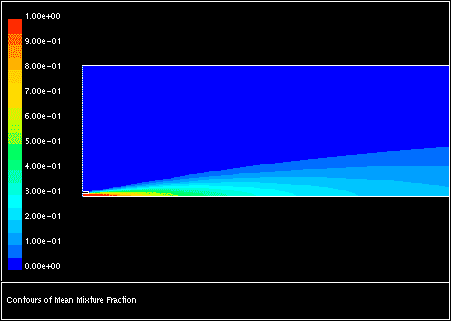 |
Figure 16.11.2: Predicted Contours of CO
 Mass Fraction Using the Non-Premixed Combustion Model
 |


 Previous:
16.10.4 Solving the Flow
Previous:
16.10.4 Solving the Flow
Up:
16. Modeling Non-Premixed Combustion
Next:
16.11.1 Postprocessing for Inert
Release 12.0 © ANSYS, Inc. 2009-01-29 ![[ANSYS, Inc. Logo]](fluentlogo.gif)

