![[ANSYS, Inc. Logo]](fluentlogo.gif)


|
|
|
The approach is to compute
 or
or
 for boundary cells on the specified viscous wall zones, define the minimum and maximum allowable
 or
or
 , and mark and/or adapt the appropriate cells. Cells with
 or
or
 values below the minimum allowable threshold will be marked for coarsening and cells with
 or
or
 values above the maximum allowable threshold will be marked for refinement (unless coarsening or refinement has been disabled).
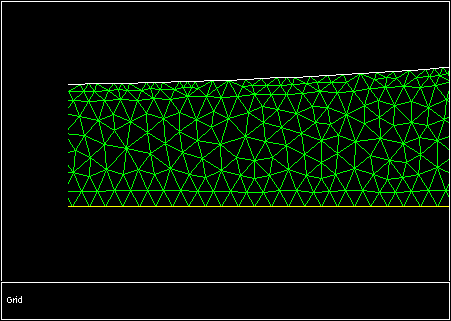
Figure
19.8.1 shows the mesh for a duct flow, where the top boundary is the wall and the bottom boundary is the symmetry plane. After an initial solution, it was determined that
 values of the cells on the wall boundary were too large, and
 adaption was used to refine them. The resulting mesh is shown in Figure
19.8.2. This figure shows that the height of the cells along the wall boundary has been reduced during the refinement process. However, the cell-size distribution on the wall after refinement is much less uniform than in the original mesh, which is an adverse effect of
adaption was used to refine them. The resulting mesh is shown in Figure
19.8.2. This figure shows that the height of the cells along the wall boundary has been reduced during the refinement process. However, the cell-size distribution on the wall after refinement is much less uniform than in the original mesh, which is an adverse effect of
 adaption.
See
this section in the separate
User's Guide for guidelines on recommended values of
 or
or
 for different near-wall treatments.
Previous:
19.8 Yplus/Ystar Adaption

 Adaption