![[ANSYS, Inc. Logo]](fluentlogo.gif)


|
|
|
The viscosities need the specification of the granular temperature
for the
 solids phase. Here we use an algebraic equation from the
granular temperature transport equation. This is only applicable for dense fluidized beds where the convection and the diffusion term can be neglected under the premise that production and dissipation of granular energy are in equilibrium.
solids phase. Here we use an algebraic equation from the
granular temperature transport equation. This is only applicable for dense fluidized beds where the convection and the diffusion term can be neglected under the premise that production and dissipation of granular energy are in equilibrium.
| where | |||
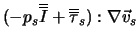 |
= | the generation of energy by the solid stress tensor | |
 |
= | the collisional dissipation of energy | |
 |
= | the energy exchange between the
 | |
fluid or solid phase and the
 solid phase solid phase |
The collisional dissipation of energy,
 , represents the rate of energy dissipation within the
 solids phase due to collisions between particles. This term is represented by the expression derived by Lun et al. [
208]
solids phase due to collisions between particles. This term is represented by the expression derived by Lun et al. [
208]
 |
(16.4-25) |
The transfer of the kinetic energy of random fluctuations in particle velocity from the
 solids phase to the
 fluid or solid phase is represented by
 [
110]:
[
110]:
 |
(16.4-26) |
ANSYS FLUENT allows you to solve for the granular temperature with the following options:
This is obtained by neglecting convection and diffusion in the transport equation (Equation 16.4-24) [ 343].
This is useful in very dense situations where the random fluctuations are small.
Previous:
16.4.7 Granular Properties
