![[ANSYS, Inc. Logo]](fluentlogo.gif)


|
|
|
A number of industrially important processes, such as distillation, absorption and extraction, bring into contact two phases which are not at equilibrium. The rate at which a species is transferred from one phase to the other depends on the departure of the system from equilibrium. The quantitative treatment of these rate processes requires knowledge of the equilibrium states of the system. Apart from these cases, vapor-liquid equilibrium (VLE) relationships in multicomponent systems are needed for the solution of many other classes of engineering problems, such as the computation of evaporation rates in spray combustion applications.
In
ANSYS FLUENT the rate of vaporization of a single component droplet is computed from Equation
15.4-12, where
 is the equilibrium concentration of the droplet species in the gas phase, and is computed in Equation
15.4-13 as:
is the equilibrium concentration of the droplet species in the gas phase, and is computed in Equation
15.4-13 as:
where
 is the droplet temperature, and
 is the saturation pressure of the droplet species at
 .
.
For the general case where N components are evaporating from a droplet (distillation), the evaporation rate of each species is again given by Equation
15.4-12; however,
 in Equation
15.5-1 must be replaced by
in Equation
15.5-1 must be replaced by
 , the partial pressure of species
 , to calculate the concentration of
 at the droplet surface.
The partial pressure of species
 can be obtained from the general expression for two phase equilibrium, equating the fugacity of the liquid and vapor mixture components [
275]:
can be obtained from the general expression for two phase equilibrium, equating the fugacity of the liquid and vapor mixture components [
275]:
where
 is the mole fraction,
 is the fugacity coefficient for the species
 in the mixture, and
 is the absolute pressure. The superscripts
 and
and
 are the vapor and the liquid phase variables, respectively. The fugacity coefficients account for the nonideality in the gas and liquid mixture. The fugacity of the liquid phase can be calculated from the pure component's saturation pressure
 [
325]:
[
325]:
Here,
 is the fugacity coefficient for pure
 at the saturation pressure;
 is the activity coefficient for species
 in the mixture, and accounts for the nonideality in the liquid phase;
 is the particle surface temperature. We assume perfect thermal conductivity inside the particle, so the particle temperature is used instead;
 is the universal gas constant;
 is the molar volume of the liquid. The exponential term is the Poynting correction factor and accounts for the compressibility effects within the liquid. Except at high pressures, the Poynting factor is usually negligible. Under low pressure conditions where the gas phase may be assumed to be ideal,
 and
and
 . Furthermore, if the liquid is also assumed to be ideal,
 , then Equation
15.5-2 reduces to Raoult's law,
, then Equation
15.5-2 reduces to Raoult's law,
Raoult's law is the default vapor-liquid equilibrium expression used in the ANSYS FLUENT multicomponent droplet model. However, there is a UDF hook available for user-defined vapor-liquid equilibrium models.
While Raoult's law represents the simplest form of the VLE equation, keep in mind that it is of limited use, as the assumptions made for its derivation are usually unrealistic. The most critical assumption is that the liquid phase is an ideal solution. This is not likely to be valid, unless the system is made up of species of similar molecular sizes and chemical nature, such as in the case of benzene and toluene, or n-heptane and n-hexane.
When Raoult's law is applicable, the vaporization rate of each species from a multicomponent droplet can be computed from Equation
15.4-12, with the equilibrium concentration of species i in the gas phase
 computed as:
where
 is the droplet temperature,
 is the mole fraction of species i in the droplet, and
 is the saturation pressure of species i at
 .
.
For higher pressures, especially near or above the critical point of the components, real gas effects must be considered. Most models describing the fugacity coefficients use a cubic equation of state with the general form:
 |
(15.5-6) |
where
 is the molar volume. For in-cylinder applications, the Peng-Robinson equation of state is often used [
265], where
is the molar volume. For in-cylinder applications, the Peng-Robinson equation of state is often used [
265], where
 ,
,
 , and
, and
 :
:
 |
(15.5-7) |
This equation defines the compressibility
 |
(15.5-8) |
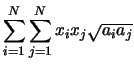
The implementation of the Peng-Robinson equation of state in
ANSYS FLUENT uses this expression for both phases, the particle liquid and the vapor phase. The parameters
 and
and
 are determined by the composition using a simple mixing law:
 |
 |
 |
|
 |
 |
 |
(15.5-9) |
where
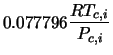
 is the number of components in the mixture. The pure component parameters can be obtained using the relationship with the Peng-Robinson constants:
where
 is the critical temperature,
 is the critical pressure and
 is the accentric factor of the component
 .
.
The fugacities of the components depend on the compressibility of the liquid and vapor phase:
 |
(15.5-11) |
where
 is the residual Helmholtz energy, which is a function of the compressibility:
![\frac{A^\gamma}{RT}=\int_V^\infty[1-Z]\frac{dV}{V}+ln Z](img6344.gif) |
(15.5-12) |
In summary, the vapor mole fraction
 , the pressure
 , and the compressibilities of the vapor (
 ) and the liquid (
 ) phase at the surface of the particle are determined from the liquid particle mole fraction of the components
 and the particle temperature
 . The surface vapor concentrations are calculated using the following equation:
Previous:
15.4.6 Multicomponent Particle Definition


![{f_i}^L = {x_i}^L{\phi_i}^L p = \gamma_{i} x_{i}^L {\phi_{sa... ...t,i}} exp\left[\frac{{V_{i}}^{L} (p - {p_{sat,i}})}{RT}\right]](img6298.gif)




![$\displaystyle \left(4.57235 \frac{R^2 T_{c,i}^2}{p_{c,i}}\right)\left[ 1+(0.48... ...74 \omega_i -0.176{\omega_i}^2)\left(1-\frac{T}{T_{c,i}}\right)^{1/2}\right]^2$](img6334.gif)