![[ANSYS, Inc. Logo]](fluentlogo.gif)


|
|
|
A detailed reaction mechanism for sulfur oxidation has been proposed by Kramlich [
172]. The mechanism consists of 20 reversible reactions and includes 12 species (
 ,
,
 ,
,
 ,
,
 ,
,
 ,
,
 ,
,
 ,
,
 ,
,
 ,
,
 ,
,
 and
and
 ). The mechanism has been reduced to 8 steps and 10 species (with
 and
and
 removed), and validated in Perfectly Stirred Reactor (PSR) and Plug Flow Reactor (PFR) simulations. Table
13.2.1 lists the reduced mechanism with the modified rate constants. For reduction calculations O and OH concentrations have been calculated through partial equilibrium assumptions based on
removed), and validated in Perfectly Stirred Reactor (PSR) and Plug Flow Reactor (PFR) simulations. Table
13.2.1 lists the reduced mechanism with the modified rate constants. For reduction calculations O and OH concentrations have been calculated through partial equilibrium assumptions based on
 and
and
 concentrations, respectively.
 was used as the dilutant. Since each reaction of the eight-step reduced mechanism is reversible, for each adjacent pair of reactions given in Table
13.2.1, the second reaction is in fact the reverse reaction of the first.
was used as the dilutant. Since each reaction of the eight-step reduced mechanism is reversible, for each adjacent pair of reactions given in Table
13.2.1, the second reaction is in fact the reverse reaction of the first.
The reduced mechanism given in Table
13.2.1 closely follows the
 concentration levels but slightly overpredicts the
 concentrations at temperatures below 1500 K. Above 1500 K, both mechanisms are in close agreement for
 and
and
 concentration predictions. However, SO and SH are not well correlated by the reduced mechanism when compared against the predictions using the original detailed mechanism.
A major concern in these mechanisms is the presence of H radical and the method in which to calculate its concentration in the flow field. At present, the concentration of H radical is assumed to be proportional to the O radical concentration, which can be evaluated from one of the existing methods in ANSYS FLUENT; viz. Partial Equilibrium (Section 13.1.3) or Equilibrium (Section 13.1.3). The user is then given the option to vary the proportionality constant. Although this assumption is open to debate, the lack of simple relation to calculate the H radical concentration in a flame has prompted the present choice.
Present implementation allows the user to either include or remove SO
 from the calculations. Also, depending on the form of fuel sulfur release (e.g.,
 or SO
or SO
 ) the species
 may or may not be present for the calculation. The user is also given the extended option of partitioning the intermediate fuel sulfur species to
 and
and
 . However, there is no literature to guide the user on how to select a correct partition fraction.
| Reaction | A | b | E |

 |
1.819702E+07
9.375623E+06 |
0.0E+00
0.0E+00 |
7.484300E+03
6.253660E+04 |

 |
1.380385E+02
3.104557E+07 |
0.0E+00
0.0E+00 |
3.742150E+03
1.218543E+05 |

 |
1.621810E+08
7.691299E+09 |
0.0E+00
0.0E+00 |
2.565926E+03
1.187023E+05 |
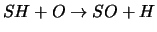
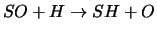 |
3.548135E+08
2.985385E+09 |
0.0E+00
0.0E+00 |
2.687316E+03
1.694600E+05 |

 |
4.365162E+03
9.885528E+08 |
0.0E+00
0.0E+00 |
1.380493E+04
6.035996E+04 |

 |
4.466832E+05
1.663412E+06 |
0.0E+00
0.0E+00 |
2.703222E+04
7.613643E+04 |

 |
1.096478E+03
8.669613E+14 |
0.0E+00
0.0E+00 |
0.000000E+00
3.819463E+05 |

 |
8.709647E+09 k
1.905464E+14 |
-1.8E+00
0.0E+00 |
0.000000E+00
5.207365E+05 |
A is in m
 /gmol-s, E is J/gmol (assumed 1 cal = 4.18585 J), A units for the thirteenth reaction is m
 /gmol
/gmol
 -s, and A units for the fifteenth reaction is m
 /gmol
/gmol
 -s.
-s.
In addition, the following two reactions were included in ANSYS FLUENT to complete the SOx mechanism, with the rate constants taken from Hunter's work [ 135].
M = argon, nitrogen, oxygen
k
 =
=
 x
x
 exp(+4185.85/RT) m
 /gmol
/gmol
 /sec
/sec
where R = 8.313 J/gmol-K
k
 =
=
 x
x
 exp(-346123.75/RT) m
 /gmol/sec
k
 =
=
 x
x
 exp(-39765.575/RT) m
 /gmol/sec
The reverse rate of Equation 13.2-7 was determined through the equilibrium constant for that equation.
Previous:
13.2.2 Governing Equations for
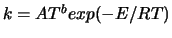 )
)
