![[ANSYS, Inc. Logo]](fluentlogo.gif)


|
|
|
The selective noncatalytic reduction of NOx (SNCR), first described by Lyon [
212], is a method to reduce the emission of NOx from combustion by injecting a selective reductant such as ammonia (NH
 ) or urea (CO(NH
 )
)
 ) into the furnace, where it can react with NO in the flue gas to form N
 . However, the reductant can be oxidized as well to form NOx. The selectivity for the reductive reactions decreases with increasing temperature [
228] while the rate of the initiation reaction simultaneously increases. This limits the SNCR process to a narrow temperature interval, or window, where the lower temperature limit for the interval is determined by the residence time.
. However, the reductant can be oxidized as well to form NOx. The selectivity for the reductive reactions decreases with increasing temperature [
228] while the rate of the initiation reaction simultaneously increases. This limits the SNCR process to a narrow temperature interval, or window, where the lower temperature limit for the interval is determined by the residence time.
Ammonia Injection
Several investigators have modeled the process using a large number of elementary reactions. A simple empirical model has been proposed by Fenimore [ 92], which is based on experimental measurements. However, the model was found to be unsuitable for practical applications. Ostberg and Dam-Johansen [ 260] proposed a two-step scheme describing the SNCR process as shown in Figure 13.1.2, which is a single initiation step followed by two parallel reaction pathways: one leading to NO reduction, and the other to NO formation.
The reaction orders of NO and NH
 at 4% volume O
 and the empirical rate constants
 and
and
 for Equations
13.1-87 and
13.1-88, respectively, have been estimated from work done by Brouwer et al. [
40]. The reaction order of NO was found to be 1 for Equation
13.1-87 and the order of NH
for Equations
13.1-87 and
13.1-88, respectively, have been estimated from work done by Brouwer et al. [
40]. The reaction order of NO was found to be 1 for Equation
13.1-87 and the order of NH
 was found to be 1 for both reactions. As such, the following reaction rates for NO and NH
 , at 4% volume O
 , were proposed:
The rate constants
 and
and
 have units of m
 /gmol-s, and are defined as

where
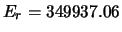 J/gmol and
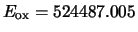 J/gmol.
This model has been shown to give reasonable predictions of the SNCR process in pulverized coal and fluidized bed combustion applications. The model also captures the influence of the most significant parameters for SNCR, which are the temperature of the flue gas at the injection position, the residence time in the relevant temperature interval, the NH
 to NO molar ratio, and the effect of combustible additives. This model overestimates the NO reduction for temperatures above the optimum temperature by an amount similar to that of the detailed kinetic model of Miller and Bowman [
228].
to NO molar ratio, and the effect of combustible additives. This model overestimates the NO reduction for temperatures above the optimum temperature by an amount similar to that of the detailed kinetic model of Miller and Bowman [
228].
|
|
The SNCR process naturally occurs when NH
 is present in the flame as a fuel N intermediate. For this reason, even if the SNCR model is not activated and there is no reagent injection, the natural SNCR process may still occur in the flame. The temperature range or "window" at which SNCR may occur is 1073 K is present in the flame as a fuel N intermediate. For this reason, even if the SNCR model is not activated and there is no reagent injection, the natural SNCR process may still occur in the flame. The temperature range or "window" at which SNCR may occur is 1073 K
 T T
 1373 K. To model your case without using the natural SNCR process, please contact your support engineer for information on how to deactivate it. 1373 K. To model your case without using the natural SNCR process, please contact your support engineer for information on how to deactivate it.
|
Urea Injection
Urea as a reagent for the SNCR process is similar to that of injecting ammonia and has been used in the power station combustors to reduce NO emissions successfully. However, both reagents, ammonia and urea, have major limitations as a NOx reducing agent. The narrow temperature "window" of effectiveness and mixing limitations are difficult factors to handle in a large combustor. The use of urea instead of ammonia as the reducing agent is attractive because of the ease of storage and handling of the reagent.
The SNCR process using urea is a combination of Thermal DeNOx (SNCR with ammonia) and RAPRENOx (SNCR using cyanuric acid that, under heating, sublimes and decomposes into isocyanic acid) since urea most probably decomposes into ammonia and isocyanic acid [ 228].
One problem of SNCR processes using urea is that slow decay of HNCO as well as the reaction channels leading to N2O and CO can significantly increase the emission of pollutants other than NO. Urea seems to involve a significant emission of carbon-containing pollutants, such as CO and HNCO.
Also, some experimental observations [
297] show that SNCR using urea is effective in a narrow temperature window that is shifted toward higher temperatures when compared to Thermal DeNOx processes at the same value of the ratio of nitrogen in the reducing agent and in NO in the feed,
 . The effect of increasing the
 value is to increase the efficiency of abatement, while the effect of increasing
 concentration depends on the temperature considered.
The model described here is proposed by Brouwer et al. [
40] and is a seven-step reduced kinetic mechanism. Brouwer et al. [
40] assumes that the breakdown of urea is instantaneous and 1 mole of urea is assumed to produce 1.1 moles of
 and 0.9 moles of HNCO. The work of Rota et al. [
297] proposed a finite rate two-step mechanism for the breakdown of urea into ammonia and HNCO.
and 0.9 moles of HNCO. The work of Rota et al. [
297] proposed a finite rate two-step mechanism for the breakdown of urea into ammonia and HNCO.
The seven-step reduced mechanism is given in Table 13.1.2 and the two-step urea breakdown mechanism is given in Table 13.1.3.
where the units of A, in Tables 13.1.2 and 13.1.3, are m-gmol-sec and E units are J/gmol.
Transport Equations for Urea, HNCO, and NCO
When the SNCR model with urea injection is employed, in addition to the usual transport equations, ANSYS FLUENT solves the following three additional mass transport equations for urea, HNCO and NCO species.
where
 ,
,
 and
and
 are mass fractions of urea, HNCO and NCO in the gas phase. Source terms
 ,
,
 and
and
 are determined according to the rate equations given in Tables
13.1.2 and
13.1.3 and the additional source terms due to reagent injection. These additional source terms are determined next. The source terms in the transport equations can be written as follows:
are determined according to the rate equations given in Tables
13.1.2 and
13.1.3 and the additional source terms due to reagent injection. These additional source terms are determined next. The source terms in the transport equations can be written as follows:
 |
(13.1-94) |
 |
(13.1-95) |
 |
(13.1-96) |
Apart from the source terms for the above three species, additional source terms for
 ,
,
 and
and
 are also determined as follows, which should be added to the previously calculated sources due to fuel NOx:
 |
(13.1-97) |
 |
(13.1-98) |
 |
(13.1-99) |
Source terms
 for
for
 species are determined from the rate equations given in Tables
13.1.2 and
13.1.3.
species are determined from the rate equations given in Tables
13.1.2 and
13.1.3.
Urea Production due to Reagent Injection
The rate of urea production is equivalent to the rate of reagent release into the gas phase through droplet evaporation:
 |
(13.1-100) |
where
 is the rate of reagent release from the liquid droplets to the gas phase (kg/s) and
 is the cell volume (
 ).
).
 Production due to Reagent Injection
If the urea decomposition model is set to the
user-specified option, then the rate of
 production is proportional to the rate of reagent release into the gas phase through droplet evaporation:
 |
(13.1-101) |
where
 is the rate of reagent release from the liquid droplets to the gas phase (kg/s),
 is the mole fraction of
 in the
 /
/
 mixture created from urea decomposition and
 is the cell volume (
 ).
).
HNCO Production due to Reagent Injection
If the urea decomposition model is set to the user-specified option, then the rate of HNCO production is proportional to the rate of reagent release into the gas phase through droplet evaporation:
 |
(13.1-102) |
where
 , the injection source term, is the rate of reagent release from the liquid droplets to the gas phase (kg/s),
 is the mole fraction of HNCO in the
 /
/
 mixture created from urea decomposition and
 is the cell volume (
 ).
).
|
|
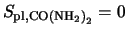
The mole conversion fractions (MCF) for species
 and HNCO are determined through the user species values such that if one mole of urea decomposes into 1.1 moles of and HNCO are determined through the user species values such that if one mole of urea decomposes into 1.1 moles of
 and 0.9 moles of HNCO, then and 0.9 moles of HNCO, then
 = 0.55 and = 0.55 and
 = 0.45. When the
user-specified option is used for urea decomposition, then = 0.45. When the
user-specified option is used for urea decomposition, then
 . .
|
However, the default option for urea decomposition is through rate limiting reactions given in Table
13.1.3 and the source terms are calculated accordingly. In this case, both values of
 and
and
 are zero.
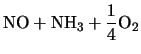
Previous:
13.1.7 NOx Reduction by



![$\displaystyle -k_r[\mbox{NO}][\mbox{NH$_3$}] + k_{\rm ox}[\mbox{NH$_3$}][\mbox{O$_2$}]$](img4914.gif)


![$\displaystyle -k_r [\mbox{NO}][\mbox{NH$_3$}] - k_{\rm ox}[\mbox{NH$_3$}][\mbox{O$_2$}]$](img4917.gif)













