![[ANSYS, Inc. Logo]](fluentlogo.gif)


|
|
|
ISAT is a powerful tool that enables realistic chemistry to be incorporated in multi-dimensional flow simulations by accelerating the chemistry calculations. Typical speed-ups of 100-fold are common. This power is apparent if one considers that with a 100-fold speed-up, a simulation that would take three months without ISAT can be run in one day.
At the start of an ANSYS FLUENT simulation using ISAT, the ISAT table is empty. For the first reaction step, Equation 11.3-8 is integrated with a stiff ODE solver. This is called Direct Integration (DI). The first table entry is created and consists of:


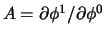
The next reaction mapping is calculated as follows: The initial composition vector for this particle is denoted
 , where the subscript
 denotes a
query. The existing table (consisting of one entry at this stage) is queried by interpolating the new mapping as
denotes a
query. The existing table (consisting of one entry at this stage) is queried by interpolating the new mapping as
The mapping gradient is hence used to linearly interpolate the table when queried. The ellipsoid of accuracy (EOA) is the elliptical space around the table point
 where the linear approximation to the mapping is accurate to the specified tolerance,
 .
.
If the query point
 is within the EOA, then the linear interpolation by Equation
11.3-9 is sufficiently accurate, and the mapping is
retrieved. Otherwise, a direct integration (DI) is performed and the mapping error
is within the EOA, then the linear interpolation by Equation
11.3-9 is sufficiently accurate, and the mapping is
retrieved. Otherwise, a direct integration (DI) is performed and the mapping error
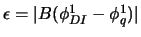 is calculated (here,
 is a scaling matrix). If this error is smaller than the specified error tolerance (
 ), then the original interpolation
 is accurate and the EOA is
grown so as to include
is accurate and the EOA is
grown so as to include
 . If not, a new table entry is
added.
. If not, a new table entry is
added.
Table entries are stored as leaves in a binary tree. When a new table entry is
added, the original leaf becomes a node with two leaves--the original leaf and the new entry. A cutting hyper-plane is created at the new node, so that the two leaves are on either side of this cutting plane. A composition vector
 will hence lie on either side of this hyper-plane.
The ISAT algorithm is summarized as follows:
 the table is traversed to identify a leaf whose composition
 is close to
 .
.
 lies within the EOA of the leaf, then the mapping
 is
retrieved using interpolation by Equation
11.3-9. Otherwise, Direct Integration (DI) is performed and the error
is
retrieved using interpolation by Equation
11.3-9. Otherwise, Direct Integration (DI) is performed and the error
 between the DI and the linear interpolation is measured.
 is less than the tolerance, then the ellipsoid of accuracy is
grown and the DI result is returned. Otherwise, a new table entry is
added.
is less than the tolerance, then the ellipsoid of accuracy is
grown and the DI result is returned. Otherwise, a new table entry is
added. At the start of the simulation, most operations are adds and grows. Later, as more of the composition space is tabulated, retrieves become frequent. Since adds and grows are very slow whereas retrieves are relatively quick, initial ANSYS FLUENT iterations are slow but accelerate as the table is built.
Previous:
11.3.3 Particle Reaction
