![[ANSYS, Inc. Logo]](fluentlogo.gif)


|
|
|
The Extended Coherent Flamelet Model (ECFM) [ 274] is a more refined premixed combustion model than the Zimont Turbulent Flame Closure. It has theoretically greater accuracy, but is less robust and requires greater computational effort to converge.
The ECFM model solves an additional equation for the flame area density, denoted
 , which is ultimately used to model the mean reaction rate in Equation
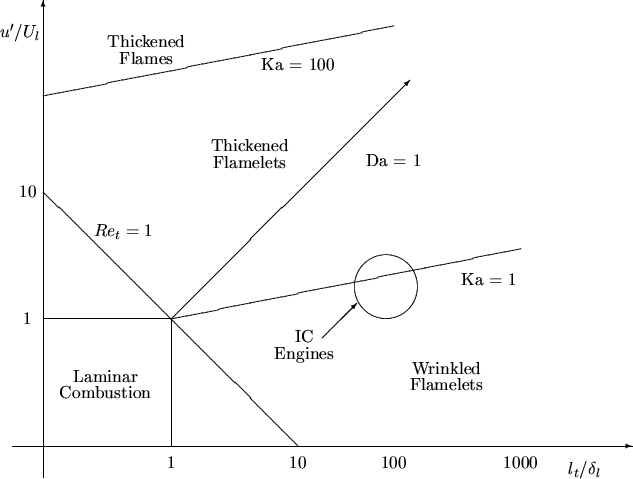
9.2-1. The model assumes that the smallest turbulence length scales (Kolmogorov eddies) are larger than the laminar flame thickness, so the effect of turbulence is to wrinkle the laminar flame sheet, however the internal laminar flame profile is not distorted. The increased surface area of the flame results in increased net fuel consumption and an increased flame speed. The range of applicability of the ECFM model is illustrated on the Borghi diagram in Figure
9.3.1, where the wrinkled flamelets regime is indicated below the
, which is ultimately used to model the mean reaction rate in Equation
9.2-1. The model assumes that the smallest turbulence length scales (Kolmogorov eddies) are larger than the laminar flame thickness, so the effect of turbulence is to wrinkle the laminar flame sheet, however the internal laminar flame profile is not distorted. The increased surface area of the flame results in increased net fuel consumption and an increased flame speed. The range of applicability of the ECFM model is illustrated on the Borghi diagram in Figure
9.3.1, where the wrinkled flamelets regime is indicated below the
 line. Typical Internal Combustion (IC) engines typically operate in this wrinkled flamelet range.
An expression for the transport of the net flame area per unit volume, or flame area density,
 , can be derived based on these assumptions [
44]:
, can be derived based on these assumptions [
44]:
| where | |||
 |
= | mean flame area density | |
Sc
 |
= | turbulent Schmidt number | |
 |
= | turbulent viscosity | |
 |
= | density | |
 |
= | Source due to turbulence interaction | |
 |
= | Source due to dilatation in the flame | |
 |
= | Source due to expansion of burned gas | |
 |
= | Dissipation of flame area |
Equation 9.3-1 requires closure terms for the production and destruction terms for flame area density. Several families of closure terms have been put forth in the literature [ 274]. ANSYS FLUENT uses the closure described in the following section.
Previous:
9.2.2 Turbulent Flame Speed