![[ANSYS, Inc. Logo]](fluentlogo.gif)


|
|
|
For non-adiabatic steady flamelets, ANSYS FLUENT follows the approach of [ 27, 240] and assumes that flamelet species profiles are unaffected by heat loss/gain from the flamelet. No special non-adiabatic flamelet profiles need to be generated, avoiding a very cumbersome preprocessing step. In addition, the compatibility of ANSYS FLUENT with external steady flamelet generation packages (e.g., OPPDIF, CFX-RIF, RUN-1DL) is retained. The disadvantage to this model is that the effect of the heat losses on the species mass fractions is not taken into account. Also, the effect of the heat loss on the extinction limits is not taken into account.
After flamelet generation, the flamelet profiles are convoluted with the assumed-shape PDFs as in Equation 8.4-3, and then tabulated for look-up in ANSYS FLUENT. The non-adiabatic PDF tables have the following dimensions:
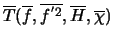 |
 for for
 = 0 (i.e., equilibrium solution) = 0 (i.e., equilibrium solution) |
 for for
 0 0 |
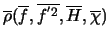 |
During the ANSYS FLUENT solution, the equations for the mean mixture fraction, mixture fraction variance, and mean enthalpy are solved. The scalar dissipation field is calculated from the turbulence field and the mixture fraction variance (Equation 8.4-4). The mean values of cell temperature, density, and species mass fraction are obtained from the PDF look-up table.
Previous:
8.5.3 Steady Laminar Flamelet