![[ANSYS, Inc. Logo]](fluentlogo.gif)


|
|
|
The available boundary conditions are
The particle rebounds the off the boundary in question with a change in its momentum as defined by the coefficient of restitution. (See Figure 23.4.1.)
The normal coefficient of restitution defines the amount of momentum in the direction normal to the wall that is retained by the particle after the collision with the boundary [ 81]:
 |
(23.4-1) |
where
 is the particle velocity normal to the wall and the subscripts 1 and 2 refer to before and after collision, respectively. Similarly, the tangential coefficient of restitution,
 , defines the amount of momentum in the direction tangential to the wall that is retained by the particle.
A normal or tangential coefficient of restitution equal to 1.0 implies that the particle retains all of its normal or tangential momentum after the rebound (an elastic collision). A normal or tangential coefficient of restitution equal to 0.0 implies that the particle retains none of its normal or tangential momentum after the rebound.
Nonconstant coefficients of restitution can be specified for wall zones with the
reflect type boundary condition. The coefficients are set as a function of the impact angle,
 , in Figure
23.4.1.
, in Figure
23.4.1.
Note that the default setting for both coefficients of restitution is a constant value of 1.0 (all normal and tangential momentum retained).
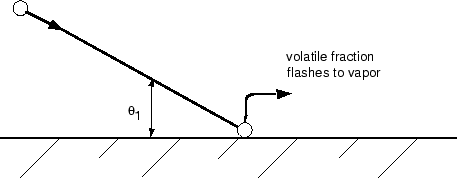
The trajectory calculations are terminated and the fate of the particle is recorded as "trapped''. In the case of evaporating droplets, their entire mass instantaneously passes into the vapor phase and enters the cell adjacent to the boundary. See Figure 23.4.2. In the case of combusting particles, the remaining volatile mass is passed into the vapor phase.
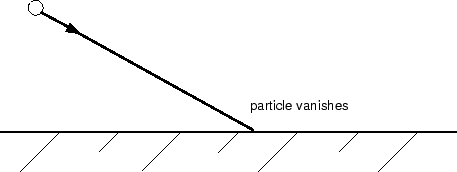
The particle is reported as having "escaped'' when it encounters the boundary in question. Trajectory calculations are terminated. See Figure 23.4.3.
The wall-jet type boundary condition is appropriate for high-temperature walls where no significant liquid film is formed, and in high-Weber-number impacts where the spray acts as a jet. The model is not appropriate for regimes where film is important (e.g., port fuel injection in SI engines, rainwater runoff, etc.).
A more detailed description of underlying theory is available in this section in the separate Theory Guide.
This boundary condition consists of four regimes: stick, rebound, spread, and splash, which are based on the impact energy and wall temperature. Detailed information on the wall-film model can be found in this section in the separate Theory Guide.
|
|
Note that the
Workpile Algorithm option is not available with the wall film boundary condition. It will be disabled automatically when chosing to simulate a wall film on a wall.
|
This boundary condition means that the particles will pass through the internal boundary. This option is available only for internal boundary zones, such as a radiator or a porous jump.
It is also possible to use a user-defined function to compute the behavior of the particles at a physical boundary. More information about user-defined functions can be found in the separate UDF Manual.
Because you can stipulate any of these conditions at flow boundaries, it is possible to incorporate mixed discrete phase boundary conditions in your ANSYS FLUENT model.
Discrete phase boundary conditions can be set for boundaries in the dialog boxes opened from the Boundary Conditions task page. When one or more injections have been defined, inputs for the discrete phase will appear in the dialog boxes (e.g., Figure 23.4.4).
Select reflect, trap, escape, wall-jet, wall-film, interior, or user-defined from the Boundary Cond. Type drop-down list under Discrete Phase Model Conditions, as shown in Figure 23.4.4. (In the Walls dialog boxes, you will need to click the DPM tab to access the Discrete Phase Model Conditions.) If you select user-defined, you can select a user-defined function in the Boundary Cond. Function drop-down list. For internal boundary zones, such as a radiator or a porous jump, you can also choose an interior boundary condition. The interior condition means that the particles will pass through the internal boundary.
If you select the reflect type at a wall (only), you can define a constant, polynomial, piecewise-linear, or piecewise-polynomial function for the Normal and Tangent coefficients of restitution under Discrete Phase Reflection Coefficients. See Section 23.4.1 for details about the boundary condition types and the coefficients of restitution. The dialog boxes for defining the polynomial, piecewise-linear, and piecewise-polynomial functions are the same as those used for defining temperature-dependent properties. See Section 8.2 for details.
Default Discrete Phase Boundary Conditions
ANSYS FLUENT makes the following assumptions regarding boundary conditions:
The coefficient of restitution can be modified only for wall boundaries.
Previous:
23.4 Setting Boundary Conditions