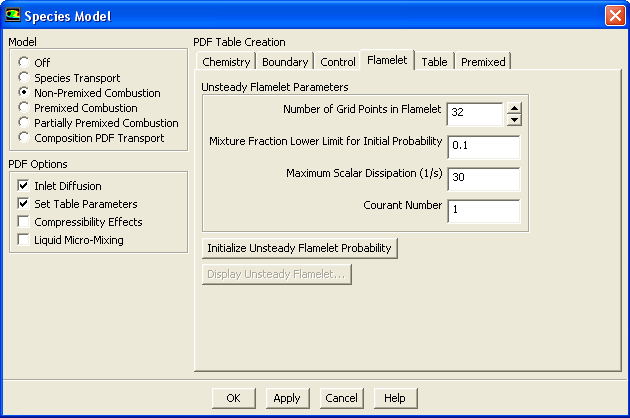
In the
Flamelet tab of the
Species Model dialog box (Figure
16.6.2), you will enter values for parameters of the flamelet.
Figure 16.6.2: The
Flamelet Tab for the Unsteady Laminar Flamelet Model
The
Unsteady Flamelet Parameters are as follows:
Number of Grid Points in Flamelet
specifies the number of mixture fraction grid points distributed between the oxidizer (
) and the fuel (
). Increased resolution will provide greater accuracy, but since the flamelet species and temperature are solved coupled and implicit in
space, the solution time and memory requirements increase with the number of
grid points.
Mixture Fraction Lower Limit for Initial Probability
is the mixture fraction above which the marker probability will be initialized to 1, and below which the marker probability will be initialized to 0. In general, it should be set greater than the stoichiometric mixture fraction.
Maximum Scalar Dissipation
is where flamelets extinguish at large scalar dissipation (mixing) rates. To prevent excessive mixing in the flamelet,
ANSYS FLUENT allows you to specify a
Maximum Scalar Dissipation rate for the 1D flamelet equations. A reasonable value for this is the steady flamelet extinction scalar dissipation. The default value of 30/s is near the steady extinction scalar dissipation of a methane-air flame at standard temperature and pressure.
Courant Number
is the number at which
ANSYS FLUENT automatically selects the time step for the probability equation based on this convective Courant number.
Click
Initialize Unsteady Flamelet Probability to initialize the unsteady flamelet and its probability marker equation.
ANSYS FLUENT is now ready for postprocessing the 1D unsteady flamelet and the 2D/3D unsteady marker probabilty equation.
![[ANSYS, Inc. Logo]](fluentlogo.gif)


 ) and the fuel (
 ). Increased resolution will provide greater accuracy, but since the flamelet species and temperature are solved coupled and implicit in
 space, the solution time and memory requirements increase with the number of
 grid points.