4.
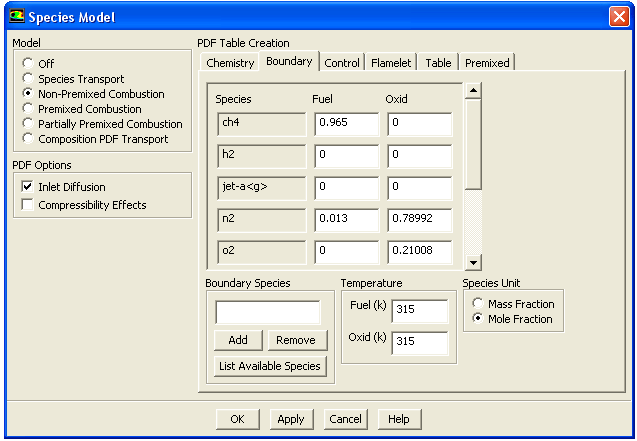
Define the chemical boundary species to be considered for the streams in the reacting system model. Note that this step is not relevant in the case of flamelet import (Figure
16.1.3).
Figure 16.1.3: Defining Chemical Boundary Species
5.
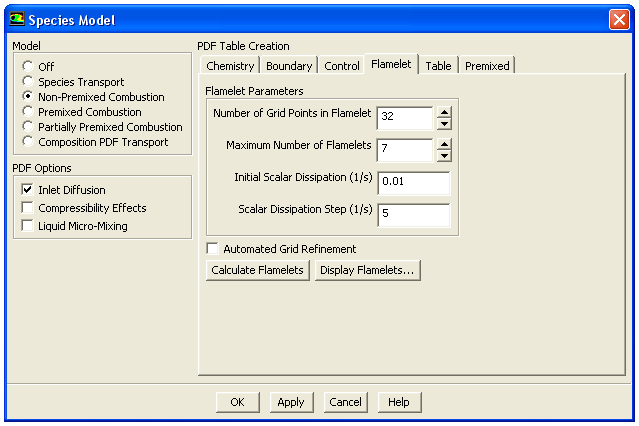
(steady laminar flamelet model only) If you are generating flamelets, compute the flamelet state relationships of species mass fractions, density, and temperature as a function of mixture fraction and scalar dissipation (Figure
16.1.4).
Figure 16.1.4: Calculating Steady Flamelets
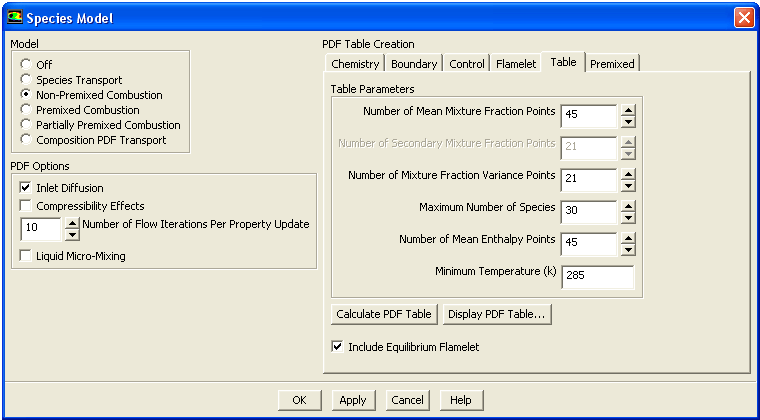
6.
Compute the final chemistry look-up table, containing mean values of species fractions, density, and temperature as a function of mean mixture fraction, mixture fraction variance, and possibly enthalpy and scalar dissipation. The contents of this look-up table will reflect your preceding inputs describing the turbulent reacting system (Figure
16.1.5).
Figure 16.1.5: Calculating the Chemistry Look-Up Table
The look-up table is the stored result of the integration of
this equation (or
this equation ) and
this equation (in the separate
Theory Guide). The look-up table will be used in
ANSYS FLUENT to determine mean species mass fractions, density, and temperature from the values of mean mixture fraction (
), mixture fraction variance (
), and possibly mean enthalpy (
) and mean scalar dissipation (
) as they are computed during the
ANSYS FLUENT calculation of the reacting flow. See
this section and
this figure and
this figure in the separate
Theory Guide.
For a problem that includes a secondary stream (and, therefore, a second mixture fraction), you will perform the first two steps listed above for the single-mixture-fraction approach and then prepare a look-up table of instantaneous properties using
this equation or
this equation in the separate
Theory Guide.
![[ANSYS, Inc. Logo]](fluentlogo.gif)


 ), mixture fraction variance (
 ), and possibly mean enthalpy (
 ) and mean scalar dissipation (
 ) as they are computed during the
ANSYS FLUENT calculation of the reacting flow. See
this section and
this figure and
this figure in the separate
Theory Guide.
) as they are computed during the
ANSYS FLUENT calculation of the reacting flow. See
this section and
this figure and
this figure in the separate
Theory Guide.