![[ANSYS, Inc. Logo]](fluentlogo.gif)


|
|
|
Overview and Limitations
An equation of state is a thermodynamic equation, which provides a mathematical relationship between two or more state functions associated with the matter, such as its temperature, pressure, volume, or internal energy. One of the simplest equations of state for this purpose is the ideal gas law, which is roughly accurate for gases at low pressures and high temperatures. However, this equation becomes increasingly inaccurate at higher pressures and lower temperatures, and fails to predict condensation from a gas to a liquid.
Introduced in 1949, the Redlich-Kwong equation of state [ 63] was a considerable improvement over other equations of that time. It is an analytic cubic equation of state and is still of interest primarily due to its relatively simple form. The original form is
 |
(8.16-1) |
where
| P | = | absolute pressure (Pa) |
| R | = |
 , universal gas constant , universal gas constant
 divided by molecular weight divided by molecular weight
 |
| V | = | specific volume (
 /kg) /kg) |
| T | = | temperature (K) |
 |
= | reduced temperature
 , where , where
 is the critical temperature is the critical temperature |
 and
and
 are constants related directly to the fluid critical pressure and temperature.
Many investigators have attempted to improve the accuracy of the Redlich-Kwong equation. ANSYS FLUENT has adopted the modified form from Aungier [ 8]. The Aungier-Redlich-Kwong equation has improved accuracy compared to the original form, especially near the critical point.
The Aungier-Redlich-Kwong real gas model is recommended for use in calculations with fluids and mixtures of fluids that are in vapor or supercritical state. The model is not available for use with fluids in the liquid state, or two-phase flows where liquid and vapor coexist.
In addition, the following limitations exist for the Aungier-Redlich-Kwong real gas model:
Equation of State for the Aungier-Redlich-Kwong Model
The Aungier-Redlich-Kwong model employs a cubic equation of state of the following form [ 8]:
and
where
| P | = | absolute pressure (Pa) |
| V | = | specific volume (
 /kg) /kg) |
| T | = | temperature (K) |
 |
= | critical temperature (K) |
 |
= | critical pressure (Pa) |
 |
= | critical specific volume (
 /kg) /kg) |
 |
= | acentric factor |
Enthalpy, Entropy, and Specific Heat Calculations
Enthalpy, entropy, and specific heat are computed in terms of the relevant ideal gas properties and the departure functions. The departure function
 of any conceptual property
 is defined as [
63]
is defined as [
63]
 |
(8.16-9) |
where
 is the value of the property as computed from the ideal gas relations. The departure function
 can be derived from basic thermodynamic relations and the equation of state.
Following the above definition, the enthalpy
 for the Aungier-Redlich-Kwong model is given by the following equations [
8]:
for the Aungier-Redlich-Kwong model is given by the following equations [
8]:
 |
(8.16-11) |
where
 |
= | ideal gas enthalpy at temperature T (J/kg) |
 |
= | pressure (Pa) |
 |
= | temperature (K) |
 |
= | specific volume (
 /kg) /kg)
|
 ,
,
 , and
, and
 are computed by Equations
8.16-3 -
8.16-8.
are computed by Equations
8.16-3 -
8.16-8.
The specific heat
 for the Aungier-Redlich-Kwong model can be derived by differentiating the equation for enthalpy with respect to
 , and is given by
 |
(8.16-13) |
where
 |
= | ideal gas specific heat at temperature T (J/kg/K) |
 |
= | pressure (Pa) |
 |
= | temperature (K) |
 |
= | specific volume (
 /kg) /kg) |
 ,
,
 , and
, and
 are computed by Equations
8.16-3 -
8.16-8.
are computed by Equations
8.16-3 -
8.16-8.
The entropy
 for the Aungier-Redlich-Kwong model is computed in
ANSYS FLUENT from the following equations [
8]:
for the Aungier-Redlich-Kwong model is computed in
ANSYS FLUENT from the following equations [
8]:
where
 |
= | ideal gas entropy at temperature T and reference pressure (J/kg/K) |
 |
= | ideal gas specific volume at temperature T and the reference pressure (
 /kg) /kg) |
 |
= | pressure (Pa) |
 |
= | temperature (K) |
 |
= | specific volume (
 /kg) /kg)
|
 ,
,
 , and
, and
 are computed by Equations
8.16-3 -
8.16-8. Note that the pressure term in Equation
8.16-14 cancels out, as both
are computed by Equations
8.16-3 -
8.16-8. Note that the pressure term in Equation
8.16-14 cancels out, as both
 and
and
 are evaluated at the reference pressure.
Critical Constants for Pure Components
Equations describing real-gas properties require the knowledge of the critical constants for pure components and mixtures. These comprise the critical temperature
 , critical pressure
 , critical specific volume
 , and the acentric factor
 .
.
Several critical constants for fluid materials in the ANSYS FLUENT property database propdb.scm have been compiled from a variety of sources available in the open literature [ 63, 55, 56, 73, 74, 77, 7].
For those fluid materials, for which the critical properties have not been found in the open literature, these have been estimated using the commercially available software CRANIUM by Molecular Knowledge Systems Inc. [ 4]: http://www.molknow.com/Cranium/ cranium.htm
Critical property values for many hydrocarbon and nitrogenous radical species have been obtained from Tsang and Brezinsky (2006) [ 83]. Where the critical properties for the radicals were not available in the literature, these were estimated using a modification of the Joback method (Polling et al., 2001). This assumes that the radical site constitutes a distinct group with zero group contribution and utilizes the group contribution values for stable species.
The critical properties of coal volatiles have been estimated assuming that the volatiles can be approximated by a mixture of CO, CO
 , H
, H
 , CH
, CH
 , and C
 H
H
 [
54] in such a way, that the atom composition and the net calorific value of the volatiles is similar to that of the assumed mixture. The critical properties of the lignite and biomass volatiles have been assumed equal to those of formaldehyde. The critical properties of diesel, kerosene and jet-a fuels have been set equal to those of decane.
[
54] in such a way, that the atom composition and the net calorific value of the volatiles is similar to that of the assumed mixture. The critical properties of the lignite and biomass volatiles have been assumed equal to those of formaldehyde. The critical properties of diesel, kerosene and jet-a fuels have been set equal to those of decane.
Calculations for Mixtures
For the computation of properties in real-gas mixtures,
ANSYS FLUENT follows the so called pseudocritical method [
63]. According to this method, the behavior and properties of a real gas mixture will be the same as that of a pure component, to which appropriate critical constants are assigned. These mixture critical constants are functions of the mixture composition and pure component critical properties, and are sometimes called pseudocritical constants, because their values are generally expected to be different from the true mixture critical constants that may be determined experimentally. However for computational purposes they are the appropriate critical constant values for the mixture. According to the pseudocritical method,
ANSYS FLUENT applies Equations
8.16-2 -
8.16-15 also for mixtures, where the critical temperature
 , critical pressure
 , critical specific volume
 , and acentric factor
 , are replaced by the corresponding mixture critical constants, critical temperature
 , critical pressure
 , critical specific volume
 , and acentric factor
 .
.
The following options are available in ANSYS FLUENT for the calculation of the mixture pseudocritical constants:
 for a real gas mixture is the mole fraction average [
63]. This method is recommended for mixtures where the pure component critical properties for all components are not very different:
for a real gas mixture is the mole fraction average [
63]. This method is recommended for mixtures where the pure component critical properties for all components are not very different:
where
 |
= | mixture pseudocritical constant |
| (temperature, pressure, specific volume or acentric factor) | ||
 |
= | critical constant of component i |
| (temperature, pressure, specific volume or acentric factor) | ||
 |
= | mole fraction of component i |
 |
= | number of components in mixture |
 , the pseudocritical pressure
 , and the pseudocritical specific volume
 can be computed from the Redlich-Kwong mixing rule as [
8]:
can be computed from the Redlich-Kwong mixing rule as [
8]:
where
 |
= | mixture pseudocritical temperature (K) |
 |
= | mixture pseudocritical pressure (Pa) |
 |
= | mixture pseudocritical specific volume (
 /kg) /kg) |
 |
= | critical temperature for component i (K) |
 |
= | critical pressure for component i (Pa) |
 |
= | critical specific volume for component i (
 /kg) /kg) |
 |
= | mole fraction for component i |
 |
= | number of components in mixture |
Using the Aungier-Redlich-Kwong Real Gas Model
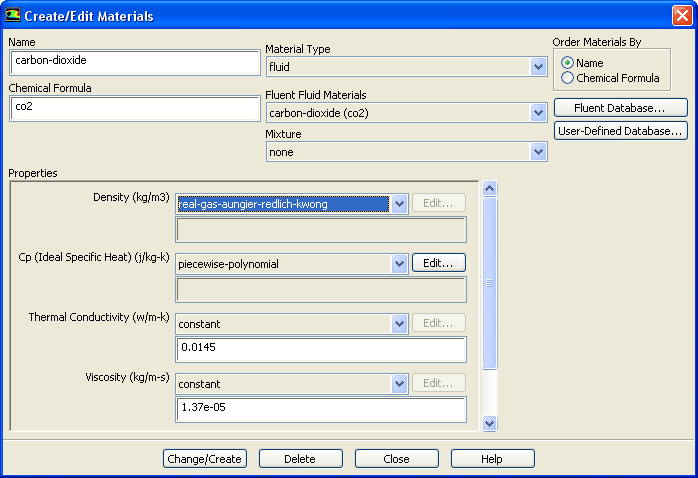
In all cases, you will activate the Aungier-Redlich-Kwong real gas model in the Create/Edit Materials dialog box.
 Materials
 Create/Edit...
The required inputs for the Angier-Redlich-Kwong real gas model for single component flow and mixtures are described below.
Single Component Flow
Enable the Aungier-Redlich-Kwong model for a real-gas fluid by selecting real-gas-aungier-redlich-kwong from the Density drop-down list in the Create/Edit Materials dialog box.
When the model is enabled, enter the following material properties in the dialog box:
|
|
Note that now your inputs for the specific heat in the
Materials dialog box will be used to compute the ideal property functions
 , ,
 , and , and
 in Equations
8.16-10,
8.16-12, and
8.16-14, respectively. In
ANSYS FLUENT the departure properties will be computed and added to the ideal part, to yield the real gas specific heat, enthalpy, and entropy. in Equations
8.16-10,
8.16-12, and
8.16-14, respectively. In
ANSYS FLUENT the departure properties will be computed and added to the ideal part, to yield the real gas specific heat, enthalpy, and entropy.
|
Mixtures
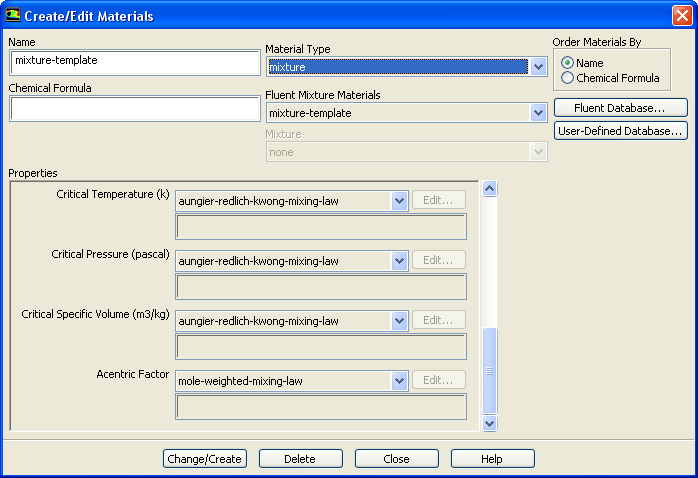
Enable the Aungier-Redlich-Kwong model for a real-gas mixture by choosing real-gas-aungier-redlich-kwong from the Density drop-down list in the Create/Edit Materials dialog box.
When the model is enabled, enter the following material properties for the mixture material in the dialog box:
You also need to enter the following material properties for each of the mixture components in the dialog box:
When you are modeling a real-gas mixture, the following methods are available for the mixture critical constants:
|
|
If you have selected
mixing-law for the mixture ideal specific heat you will also need to enter the ideal specific heat values for the individual mixture components. Similarly, if you have not selected
constant as the option for any of the critical properties, you will need to enter the corresponding pure component critical properties for the mixture components.
|
|
|
Note that now your inputs for the specific heat in the
Create/Edit Materials dialog box will be used for computing the ideal property functions
 , ,
 , and , and
 in Equations
8.16-10,
8.16-12, and
8.16-14, respectively. In
ANSYS FLUENT the departure properties will be computed and added to the ideal part, to yield the real gas specific heat, enthalpy, and entropy. in Equations
8.16-10,
8.16-12, and
8.16-14, respectively. In
ANSYS FLUENT the departure properties will be computed and added to the ideal part, to yield the real gas specific heat, enthalpy, and entropy.
|
Solution Strategies and Considerations for Aungier-Redlich-Kwong Real Gas Model Simulation
The flow modeling of real-gas flow is more complex and challenging than simple ideal-gas flow. Therefore, the solution might converge at a slower rate with real-gas flow than when running ideal-gas flow. It is recommended that you first attempt to converge your solution using first-order discretization then switch to second-order discretizations and re-iterate to convergence.
It is important to realize that the Aungier-Redlich-Kwong real gas model is not available for use with fluids in the liquid state, or two-phase flows where liquid and vapor coexist. Thus the flow conditions you are prescribing must fall within the range of the model. In case the flow conditions in your case fall inside the saturation dome, the properties are computed for the vapor phase up to the vapor spinodal curve, which defines the boundary beyond which the equation of state is no longer valid, because the local derivative of pressure with respect to volume becomes positive. State points predicted inside the dome, up to the spinodal curve, are called "metastable" because normally they only temporarily exist in small local regions until phase change occurs. For cases without phase change these states can occur and continue to persist depending on the problem setup. In some instances, the actual converged state is just within the superheated vapor limits but only transitory inside the saturation dome.
When the flow conditions fall beyond the spinodal curve, the properties are clipped at the vapor spinodal curve, and a message is displayed:
temperature is limited to the spinodal point in 22 cells on zone 13 |
Finally, when you initialize the flow, ensure that the flow conditions fall within the vapor or supercritical flow conditions that are supported by the Aungier-Redlich-Kwong model.
Postprocessing the Aungier-Redlich-Kwong Real Gas Model
All postprocessing functions properly report and display the current thermodynamic and transport properties of the selected real gas model. The thermodynamic and transport properties controlled by the Aungier-Redlich-Kwong real gas model include the following:
In addition to the properties listed above, you can also report
If you are modeling a real-gas mixture you can report the composition dependent mixture critical properties
Previous:
8.16 Real Gas Models












![T_{cm}^{1+n} = \frac{[\sum_{i=1}^n (x_i \sqrt{T_{ci}^{(2+n)}/P_{ci})}]^2}{\sum_{i=1}^n(x_i T_{ci}/P_{ci})}](img2593.gif)