![[ANSYS, Inc. Logo]](fluentlogo.gif)


|
|
|
If you are modeling a problem that involves heat transfer, you can define the viscosity as a function of temperature . Five types of functions are available:
 |
(8.4-2) | ||
 |
(8.4-3) |
|
|
The power law described here is different from the non-Newtonian power law described in Section
8.4.5.
|
For one of the first three, select
piecewise-linear,
piecewise-polynomial,
polynomial in the
Viscosity drop-down list and then enter the data pairs (
 ), ranges and coefficients, or coefficients that describe these functions Section
8.2. For Sutherland's law or the power law, choose
sutherland or
power-law respectively in the drop-down list and enter the parameters.
), ranges and coefficients, or coefficients that describe these functions Section
8.2. For Sutherland's law or the power law, choose
sutherland or
power-law respectively in the drop-down list and enter the parameters.
Sutherland Viscosity Law
Sutherland's viscosity law resulted from a kinetic theory by Sutherland (1893) using an idealized intermolecular-force potential. The formula is specified using two or three coefficients.
Sutherland's law with two coefficients has the form
where,
 |
= | the viscosity in kg/m-s |
 |
= | the static temperature in K |
 and and
 |
= | the coefficients |
 |
= | the mass fraction of species
 |
 |
= | the molecular weight of species
 |
 |
= | the Operating Pressure |
For air at moderate temperatures and pressures,
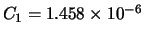 kg/m-s-K
 , and
, and
 K.
K.
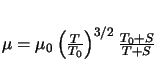
Sutherland's law with three coefficients has the form
where,
 |
= | the viscosity in kg/m-s |
 |
= | the static temperature in K |
 |
= | reference value in kg/m-s |
 |
= | reference temperature in K |
 |
= | an effective temperature in K (Sutherland constant) |
For air at moderate temperatures and pressures,
 kg/m-s,
 = 273.11 K, and
 = 110.56 K.
Inputs for Sutherland's Law
To use Sutherland's law, choose sutherland in the drop-down list to the right of Viscosity. The Sutherland Law dialog box will open, and you can enter the coefficients as follows:
|
|
Use SI units if you choose the two-coefficient method.
|
 , the
Reference Temperature
, the
Reference Temperature
 , and the
Effective Temperature
, and the
Effective Temperature
 .
.
Power-Law Viscosity Law
Another common approximation for the viscosity of dilute gases is the power-law form. For dilute gases at moderate temperatures, this form is considered to be slightly less accurate than Sutherland's law.
A power-law viscosity law with two coefficients has the form
where
 is the viscosity in kg/m-s,
 is the static temperature in K, and
 is a dimensional coefficient. For air at moderate temperatures and pressures,
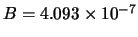 , and
, and
 .
.
A power-law viscosity law with three coefficients has the form
where
 is the viscosity in kg/m-s,
 is the static temperature in K,
 is a reference value in K,
 is a reference value in kg/m-s. For air at moderate temperatures and pressures,
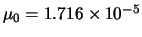 kg/m-s,
 K, and
 .
.
|
|
The non-Newtonian power law for viscosity is described in Section
8.4.5.
|
Inputs for the Power Law
To use the power law, choose power-law in the drop-down list to the right of Viscosity. The Power Law dialog box will open, and you can enter the coefficients as follows:
|
|
Note that you must use SI units if you choose the two-coefficient method.
|
 . For the
Three Coefficient Method, set the
Reference Viscosity
. For the
Three Coefficient Method, set the
Reference Viscosity
 , the
Reference Temperature
, the
Reference Temperature
 , and the
Temperature Exponent
, and the
Temperature Exponent
 .
.
Previous:
8.4.1 Input of Constant