![[ANSYS, Inc. Logo]](fluentlogo.gif)


|
|
|
The total force component along the specified force vector
 on a wall zone is computed by summing the dot product of the pressure and viscous forces on each face with the specified force vector. The terms in this summation represent the pressure and viscous force components in the direction of the vector
 :
:
 |
(20.2-1) |
| where | |||
 |
= | specified force vector | |
 |
= | pressure force vector | |
 |
= | viscous force vector | |
In addition to the actual pressure, viscous, and total forces, the associated force coefficients are also computed for each of the selected wall zones, using the reference values
(as described in
this section in the separate
User's Guide). The force coefficient is defined as force divided by
 , where
 ,
,
 , and
, and
 are the density, velocity, and area. Finally, the net values of the pressure, viscous, and total forces and coefficients for all of the selected wall zones are also computed.
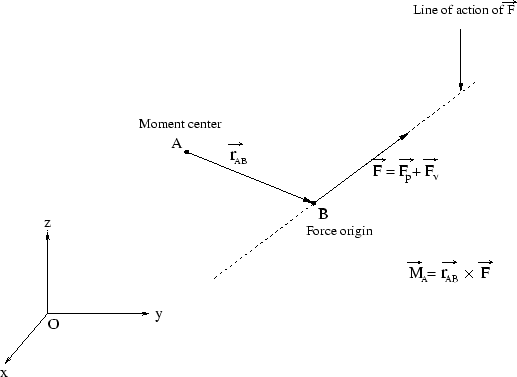
The total moment vector about a specified center
 is computed by summing the cross products of the pressure and viscous force vectors for each face with the moment vector
 , which is the vector from the specified moment center
 to the force origin
 (see Figure
20.2.1). The terms in this summation represent the pressure and viscous moment vectors:
(see Figure
20.2.1). The terms in this summation represent the pressure and viscous moment vectors:
 |
(20.2-2) |
| where | |||
 |
= | specified moment center | |
 |
= | force origin | |
 |
= | moment vector | |
 |
= | pressure force vector | |
 |
= | viscous force vector | |
Direction of the total moment vector follows the right hand rule for cross products.
Along with the actual components of the pressure, viscous, and total moments, the moment coefficients are computed for each of the selected wall zones, using the reference values (as described in
this section in the separate
User's Guide). The moment coefficient is defined as the moment divided by
 , where
 ,
,
 ,
,
 , and
, and
 are the density, velocity, area, and length. The coefficient values for the individual wall zones are also summed to yield the net values of the pressure, viscous, and total moments and coefficients for all of the selected wall zones.
Furthermore, the moments along a specified axis are computed. These moments, also known as torques , are defined as the dot product of a unit vector in the direction of the specified axis and the individual and net values of the pressure, viscous, and total moments and coefficients.
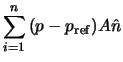
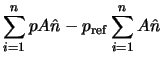
To reduce round-off error, a reference pressure is used to normalize the cell pressure for computation of the pressure force. For example, the net pressure force vector, acting on a wall zone, is computed as the vector sum of the individual force vectors for each cell face:
 |
 |
 |
(20.2-3) |
 |
 |
(20.2-4) |
where
 is the number of faces,
 is the area of the face, and
 is the unit normal to the face.
The center of pressure is the average location of the pressure. The pressure varies around the surface of an object, such that
 . The general expression for determining the center of pressure is
 |
(20.2-5) |
However, the center of pressure of a wall is also defined as the point about which the moment on the wall(s) will be zero, that is, the point on the wall where all of the forces balance. It is computed as follows:
 |
 |
 |
(20.2-6) |
 |
 |
 |
(20.2-7) |
where
 is the force acting on the selected wall and
 is the position vector from the center of pressure to the point where the force is applied.
Previous:
20.2 Forces on Boundaries