![[ANSYS, Inc. Logo]](fluentlogo.gif)


|
|
|
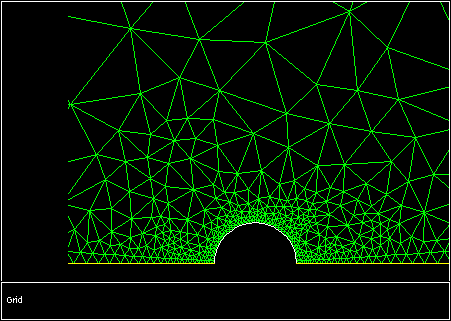
An example of the use of steady gradient adaption is the solution of the supersonic flow over a circular cylinder. The initial mesh, shown in Figure 19.3.1, is very coarse, even though it contains sufficient cells to adequately describe the shape of the cylinder. The mesh ahead of the cylinder is too coarse to resolve the shock wave that forms in front of the cylinder. In this instance, pressure is a suitable variable to be used in gradient adaption. This is because there will be a jump in pressure across the shock. However, several adaptions are necessary before the shock can be properly resolved. After several adaptions the mesh will be as shown in Figure 19.3.2.
A typical application of gradient adaption for an incompressible flow might be a mixing layer, which involves a discontinuity.
Previous:
19.3.1 Gradient Adaption Approach