![[ANSYS, Inc. Logo]](fluentlogo.gif)


|
|
|
As noted above, O'Rourke's algorithm assumes that two droplets may collide only if they are in the same continuous-phase cell. This assumption can prevent droplets that are quite close to each other, but not in the same cell, from colliding, although the effect of this error is lessened by allowing some droplets that are farther apart to collide. The overall accuracy of the scheme is second-order in space.
Probability of Collision
The probability of collision of two droplets is derived from the point of view of the larger droplet, called the collector droplet and identified below with the number 1. The smaller droplet is identified in the following derivation with the number 2. The calculation is in the frame of reference of the larger droplet so that the velocity of the collector droplet is zero. Only the relative distance between the collector and the smaller droplet is important in this derivation. If the smaller droplet is on a collision course with the collector, the centers will pass within a distance of
 . More precisely, if the smaller droplet center passes within a flat circle centered around the collector of area
 perpendicular to the trajectory of the smaller droplet, a collision will take place. This disk can be used to define the collision volume, which is the area of the aforementioned disk multiplied by the distance traveled by the smaller droplet in one time step, namely
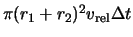 .
.
The algorithm of O'Rourke uses the concept of a collision volume to calculate the probability of collision. Rather than calculating whether or not the position of the smaller droplet center is within the collision volume, the algorithm calculates the probability of the smaller droplet being within the collision volume. It is known that the smaller droplet is somewhere within the continuous-phase cell of volume
 . If there is a uniform probability of the droplet being anywhere within the cell, then the chance of the droplet being within the collision volume is the ratio of the two volumes. Thus, the probability of the collector colliding with the smaller droplet is
Equation
15.11-2 can be generalized for parcels, where there are
 and
and
 droplets in the collector and smaller droplet parcels, respectively. The collector undergoes a mean expected number of collisions given by
The actual number of collisions that the collector experiences is not generally the mean expected number of collisions. The probability distribution of the number of collisions follows a Poisson distribution, according to O'Rourke, which is given by
where
 is the number of collisions between a collector and other droplets.
Collision Outcomes
Once it is determined that two parcels collide, the outcome of the collision must be determined. In general, the outcome tends to be coalescence if the droplets collide head-on, and bouncing if the collision is more oblique. In the reference frame being used here, the probability of coalescence can be related to the offset of the collector droplet center and the trajectory of the smaller droplet. The critical offset is a function of the collisional Weber number and the relative radii of the collector and the smaller droplet.
The critical offset is calculated by O'Rourke using the expression
where
 is a function of
 , defined as
The value of the actual collision parameter,
 , is
, is
 , where
 is a random number between 0 and 1. The calculated value of
 is compared to
 , and if
 , the result of the collision is coalescence. Equation
15.11-4 gives the number of smaller droplets that coalesce with the collector. The properties of the coalesced droplets are found from the basic conservation laws.
, the result of the collision is coalescence. Equation
15.11-4 gives the number of smaller droplets that coalesce with the collector. The properties of the coalesced droplets are found from the basic conservation laws.
In the case of a grazing collision, the new velocities are calculated based on conservation of momentum and kinetic energy. It is assumed that some fraction of the kinetic energy of the droplets is lost to viscous dissipation and angular momentum generation. This fraction is related to
 , the collision offset parameter. Using assumed forms for the energy loss, O'Rourke derived the following expression for the new velocity:
This relation is used for each of the components of velocity. No other droplet properties are altered in grazing collisions.
Previous:
15.11.2 Use and Limitations





