![[ANSYS, Inc. Logo]](fluentlogo.gif)


|
|
|
In swirling flows, conservation of angular momentum (
 or
or
 = constant) tends to create a free vortex flow, in which the circumferential velocity,
 , increases sharply as the radius,
 , decreases (with
 finally decaying to zero near
 as viscous forces begin to dominate). A tornado is one example of a free vortex. Figure
1.5.3 depicts the radial distribution of
as viscous forces begin to dominate). A tornado is one example of a free vortex. Figure
1.5.3 depicts the radial distribution of
 in a typical free vortex.
It can be shown that for an ideal free vortex flow, the centrifugal forces created by the circumferential motion are in equilibrium with the radial pressure gradient:
As the distribution of angular momentum in a non-ideal vortex evolves, the form of this radial pressure gradient also changes, driving radial and axial flows in response to the highly non-uniform pressures that result. Thus, as you compute the distribution of swirl in your ANSYS FLUENT model, you will also notice changes in the static pressure distribution and corresponding changes in the axial and radial flow velocities. It is this high degree of coupling between the swirl and the pressure field that makes the modeling of swirling flows complex.
In flows that are driven by wall rotation,
the motion of the wall tends to impart a forced vortex motion to the fluid, wherein
 or
or
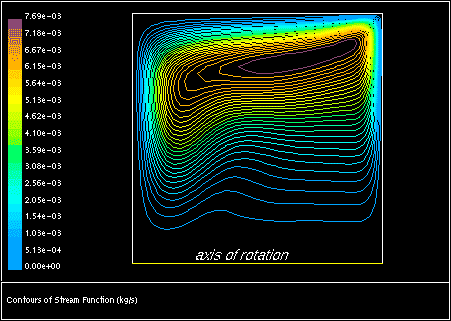
 is constant. An important characteristic of such flows is the tendency of fluid with high angular momentum (e.g., the flow near the wall) to be flung radially outward (Figure
1.5.4). This is often referred to as "radial pumping'', since the rotating wall is pumping the fluid radially outward.
is constant. An important characteristic of such flows is the tendency of fluid with high angular momentum (e.g., the flow near the wall) to be flung radially outward (Figure
1.5.4). This is often referred to as "radial pumping'', since the rotating wall is pumping the fluid radially outward.
Previous:
1.5.1 Overview of Swirling
 in a Free Vortex