![[ANSYS, Inc. Logo]](fluentlogo.gif)


|
|
|
ANSYS FLUENT solves the equations for mass conservation in the crevice geometry by assuming laminar compressible flow in the region between the piston and the top and bottom faces of the ring, and by assuming an orifice flow between the ring and the cylinder wall. The equation for the mass flow through the ring end gaps is of the form
where
 is the discharge coefficient,
 is the gap area,
 is the gas density,
 is the local speed of sound, and
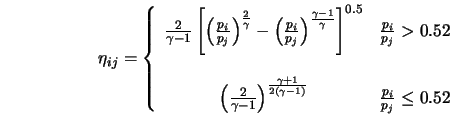
 is a compressibility factor given by
where
 is the ratio of specific heats,
 the upstream pressure and
 the downstream pressure. The equation for the mass flow through the top and bottom faces of the ring (i.e., into and out of the volume behind the piston ring) is given by
where
 is the cross-sectional area of the gap,
 is the width of the ring along which the gas is flowing,
 is the local gas viscosity,
 is the temperature of the gas and
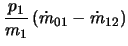
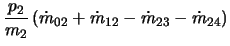
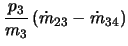
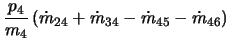
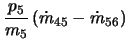
 is the universal gas constant. The system of equations for a set of three rings is of the following form:
 |
 |
 |
(12.3-4) |
 |
 |
 |
(12.3-5) |
 |
 |
 |
(12.3-6) |
 |
 |
 |
(12.3-7) |
 |
 |
 |
(12.3-8) |
where
 is the average pressure in the crevice cells and
 is the crankcase pressure input from the text interface. The expressions for the mass flows for numerically adjacent zones (e.g., 0-1, 1-2, 2-3, etc.) are given by Equation
12.3-3 and expressions for the mass flows for zones separated by two integers (e.g., 0-2, 2-4, 4-6) are given by Equations
12.3-1 and
12.3-2. Thus, there are
is the crankcase pressure input from the text interface. The expressions for the mass flows for numerically adjacent zones (e.g., 0-1, 1-2, 2-3, etc.) are given by Equation
12.3-3 and expressions for the mass flows for zones separated by two integers (e.g., 0-2, 2-4, 4-6) are given by Equations
12.3-1 and
12.3-2. Thus, there are
 equations needed for the solution to the ring-pack equations, where
 is the number of rings in the simulation.
Previous:
12.3.2 Limitations