![[ANSYS, Inc. Logo]](fluentlogo.gif)


|
|
|
The unique dependence of
 (species mass fractions, density, or temperature) on
 (Equation
8.2-11 or
8.2-13) requires that the reacting system meet the following conditions:
(Equation
8.2-11 or
8.2-13) requires that the reacting system meet the following conditions:
 and 10% CO) and you may include multiple fuel inlets. The multiple fuel inlets
must have the same composition; two or more fuel inlets with different fuel composition are not allowed (e.g., one inlet of CH
and 10% CO) and you may include multiple fuel inlets. The multiple fuel inlets
must have the same composition; two or more fuel inlets with different fuel composition are not allowed (e.g., one inlet of CH
 and one inlet of CO). Similarly, in spray combustion systems or in systems involving reacting particles, only one off-gas is permitted.
 and 79% N
 ) and you may have multiple oxidizer inlets. The multiple oxidizer inlets must, however, have the same composition. Two or more oxidizer inlets with different compositions are not allowed (e.g., one inlet of air and a second inlet of pure oxygen).
 and 10% CO). You may include multiple inlets of each fuel stream, but each fuel inlet must have one of the two defined compositions (e.g., one inlet of CH
 and one inlet of CO).
 and 79% N
 ). You may have multiple inlets of each oxidizer stream, but each oxidizer inlet must have one of the two defined compositions (e.g., one inlet of air and a second inlet of pure oxygen).
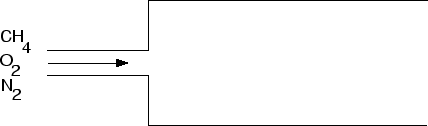
It is important to emphasize that these restrictions eliminate the use of the non-premixed approach for directly modeling premixed combustion. This is because the unburned premixed stream is far from chemical equilibrium. Note, however, that an extended mixture fraction formulation, the partially premixed model (see Chapter 10), can be applied to non-premixed (with mixed-but-unburnt regions), as well as partially premixed flames.
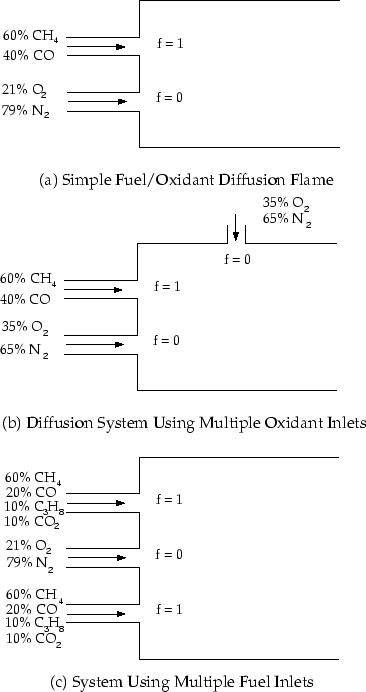
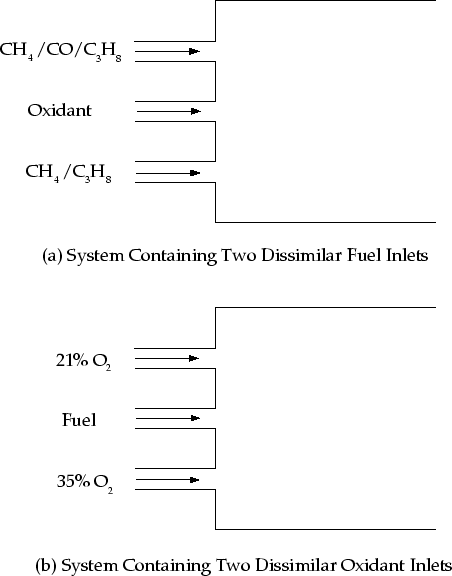
Figures 8.3.1 and 8.3.2 illustrate typical reacting system configurations that can be handled by the non-premixed model in ANSYS FLUENT. Figure 8.3.3 shows a premixed configuration that cannot be modeled using the non-premixed model.
Previous:
8.3 Restrictions and Special