![[ANSYS, Inc. Logo]](fluentlogo.gif)


|
|
|
Overview
The Eulerian multiphase model in ANSYS FLUENT allows for the modeling of multiple separate, yet interacting phases. The phases can be liquids, gases, or solids in nearly any combination. An Eulerian treatment is used for each phase, in contrast to the Eulerian-Lagrangian treatment that is used for the discrete phase model.
With the Eulerian multiphase model, the number of secondary phases is limited only by memory requirements and convergence behavior. Any number of secondary phases can be modeled, provided that sufficient memory is available. For complex multiphase flows, however, you may find that your solution is limited by convergence behavior. See this section in the separate User's Guide for multiphase modeling strategies.
ANSYS FLUENT's Eulerian multiphase model does not distinguish between fluid-fluid and fluid-solid (granular) multiphase flows. A granular flow is simply one that involves at least one phase that has been designated as a granular phase.
The ANSYS FLUENT solution is based on the following:
 -
-
 turbulence models are available, and may apply to all phases or to the mixture.
Limitations
All other features available in ANSYS FLUENT can be used in conjunction with the Eulerian multiphase model, except for the following limitations:
To change from a single-phase model, where a single set of conservation equations for momentum, continuity and (optionally) energy is solved, to a multiphase model, additional sets of conservation equations must be introduced. In the process of introducing additional sets of conservation equations, the original set must also be modified. The modifications involve, among other things, the introduction of the volume fractions
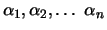 for the multiple phases, as well as mechanisms for the exchange of momentum, heat, and mass between the phases.
Previous:
16.5 Eulerian Model Theory