![[ANSYS, Inc. Logo]](fluentlogo.gif)


|
|
|
Advances in computational fluid mechanics have provided the basis for further insight into the dynamics of multiphase flows. Currently there are two approaches for the numerical calculation of multiphase flows: the Euler-Lagrange approach (discussed below) and the Euler-Euler approach (discussed in Section 16.2.1).
The Euler-Lagrange Approach
The Lagrangian discrete phase model in ANSYS FLUENT (described in this chapter) follows the Euler-Lagrange approach. The fluid phase is treated as a continuum by solving the Navier-Stokes equations, while the dispersed phase is solved by tracking a large number of particles, bubbles, or droplets through the calculated flow field. The dispersed phase can exchange momentum, mass, and energy with the fluid phase.
A fundamental assumption made in this model is that the dispersed second phase occupies a low volume fraction, even though high mass loading (
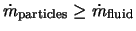 ) is acceptable. The particle or droplet trajectories are computed individually at specified intervals during the fluid phase calculation. This makes the model appropriate for the modeling of spray dryers, coal and liquid fuel combustion, and some particle-laden flows, but inappropriate for the modeling of liquid-liquid mixtures, fluidized beds, or any application where the volume fraction of the second phase cannot be neglected.
Limitations of the discrete phase model are listed in this section in the separate User's Guide.
Previous:
15. Discrete Phase