![[ANSYS, Inc. Logo]](fluentlogo.gif)


|
|
|
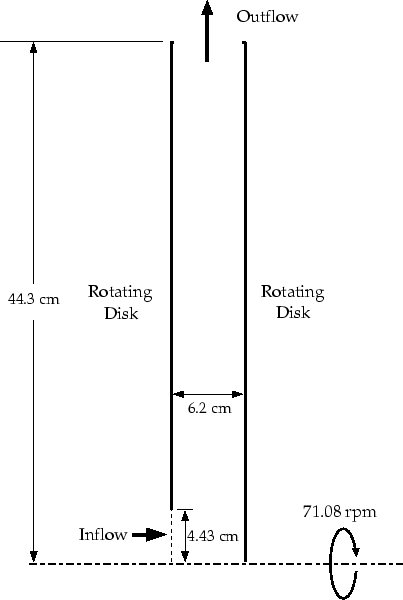
The problem to be considered is shown schematically in Figure 9.1. This case is similar to a disk cavity configuration that was extensively studied by Pincombe [1].
Air enters the cavity between two co-rotating disks. The disks are 88.6 cm in diameter and the air enters at 1.146 m/s through a circular bore 8.86 cm in diameter. The disks, which are 6.2 cm apart, are spinning at 71.08 rpm, and the air enters with no swirl. As the flow is diverted radially, the rotation of the disk has a significant effect on the viscous flow developing along the surface of the disk.
As noted by Pincombe [1], there are two nondimensional parameters that characterize this type of disk cavity flow: the volume flow rate coefficient, , and the rotational Reynolds number,
 . These parameters are defined as follows:
 |
(9.3-1) |
 |
(9.3-2) |
where
 is the volumetric flow rate,
 is the rotational speed,
 is the kinematic viscosity, and
 is the outer radius of the disks. Here, you will consider a case for which
 = 1092 and
 = 10
= 10
 .
.
Previous:
Prerequisites