|
|
|
|
|
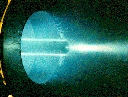
The research activity in plasma physics was devoted to the numerical simulation of the electrical breakdown and the subsequent formation of a plasma from the gas filling the reaction chamber of a Plasma Focus (PF). PFs are compact devices (originally developed by the American physicist Mather in 1968 and, independently, by the Russian physicist Nabokov in 1969) for the generation, the acceleration, the compression and the confinement of a plasma by the simultaneous action of high, pulsed electrical and magnetical fields. The closure of an external circuit onto a condensers bank, therefore the subsequent unloading of the bank over the two electrodes delimiting the device's reaction chamber, imposes a fast-growing electrical field acting on the few free charges initially present into the device. The high potential difference accelerates those particles leading them to energies proper of excitation first, then ionization phenomena by impact with the neutral molecules of the filling gas. The electrical breakdown of the gas terminates with the avalanche formation of a plasma sheath over an insulator sleeve superposed to the inner electrode.
Such a highly survolted breakdown phenomena has been under investigation by means of a Particle-In-Cell (PIC) code which models the forming plasma as a complex system of free charges individually moving in a collisional (simulated by means of a Monte Carlo Collisional module, MCC) domain, under the action of both the externally applied and the self-consistent electrical fields.
The es-cPIF code (an electrostatic-collisional Particle In cell code for plasma Focus breakdown) has been completely written from scratch, in modular Fortran 90 (Object-Oriented like), to get a suitable tool for the simulation of the breakdown in the peculiar operative conditions proper of PF devices. Still actually under development, the code let the Author retrieve some interesting preliminary results about the formation of a plasma seed by the action of avalanche ionizations in the chamber, and a further evolution of the seed towards the final plasma sheath by introducing boundary Secondary Electrons Emission (SEE) phenomena, such as the photoionization of the cathode.
|
|
|
|
|
Plasmas Simulation
|
|
|
|
Home  Research Plasmas Research Plasmas
|