FAURE_NEXT
Computes a shuffled Faure sequence.
Required Arguments
STATE — An IMSL_FAURE pointer containing the structure created by the call to FAURE_INIT. The structure contains information about the sequence. The structure should be freed using FAURE_FREE after it is no longer needed. (Input/Output)
NEXT_PT — Vector of length NDIM containing the next point in the shuffled Faure sequence, where NDIM is the dimension of the hyper-rectangle specified in FAURE_INIT. (Output)
Optional Arguments
IMSL_RETURN_SKIP — Returns the current point in the sequence. The sequence can be restarted by calling FAURE_INIT using this value for NSKIP, and using the same value for NDIM. (Input)
FORTRAN 90 Interface
Generic: CALL FAURE_NEXT (STATE, NEXT_PT [,…])
Specific: The specific interface names are S_FAURE_NEXT and D_FAURE_NEXT.
Description
Discrepancy measures the deviation from uniformity of a point set.
The discrepancy of the point set 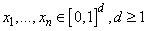 , is defined
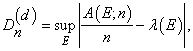
where the supremum is over all subsets of [0, 1]d of the form
 ,
λ is the Lebesque measure, and  is the number of the xj contained in E.
The sequence x1, x2, … of points [0,1]d is a low-discrepancy sequence if there exists a constant c(d), depending only on d, such that
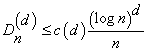
for all n>1.
Generalized Faure sequences can be defined for any prime base b≥d. The lowest bound for the discrepancy is obtained for the smallest prime b≥d, so the optional argument NBASE defaults to the smallest prime greater than or equal to the dimension.
The generalized Faure sequence x1, x2, …, is computed as follows:
Write the positive integer n in its b-ary expansion,
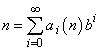
where ai(n) are integers,  .
The j-th coordinate of xn is

The generator matrix for the series,  , is defined to be

and  is an element of the
Pascal matrix,
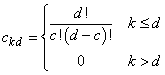
It is faster to compute a shuffled Faure sequence than to compute the Faure sequence itself. It can be shown that this shuffling preserves the low-discrepancy property.
The shuffling used is the b-ary Gray code. The function G(n) maps the positive integer n into the integer given by its b-ary expansion.
The sequence computed by this function is x(G(n)), where x is the generalized Faure sequence.
Example
In this example, five points in the Faure sequence are computed. The points are in the three-dimensional unit cube.
Note that FAURE_INIT is used to create a structure that holds the state of the sequence. Each call to FAURE_NEXT returns the next point in the sequence and updates the IMSL_FAURE structure. The final call to FAURE_FREE frees data items, stored in the structure, that were allocated by FAURE_INIT.
use faure_int
implicit none
type (s_imsl_faure), pointer :: state
real(kind(1e0)) :: x(3)
integer,parameter :: ndim=3
integer :: k
! CREATE THE STRUCTURE THAT HOLDS
! THE STATE OF THE SEQUENCE.
call faure_init(ndim, state)
! GET THE NEXT POINT IN THE SEQUENCE
do k=1,5
call faure_next(state, x)
write(*,'(3F15.3)') x(1), x(2) , x(3)
enddo
! FREE DATA ITEMS STORED IN
! state STRUCTURE
call faure_free(state)
end
Output
0.334 0.493 0.064
0.667 0.826 0.397
0.778 0.270 0.175
0.111 0.604 0.509
0.445 0.937 0.842
|
PHONE: 713.784.3131 FAX:713.781.9260 |